Heat Exchanger Vs Dual Boiler Review (Updated | Jul 29th)
The heat exchanger vs dual boiler debate defines the most critical decision for any aspiring home espresso enthusiast. Choosing incorrectly can mean inconsistent brew temperatures or excessive wait times, sabotaging both shot quality and workflow. This guide cuts through the technical noise, directly comparing heat-up speed, temperature stability, and steam power for each system. It provides a clear, expert framework to match a machine’s core design to specific brewing priorities, ensuring a confident purchase that delivers professional-grade results from the first cup.
Key Takeaways
- Choose the Titanium Saltwater Specialist for salt or chlorine pools needing corrosion-proof durability.
- The Titanium Saltwater Specialist’s 600 kBtu/hr suits large pools or light industrial use.
- Pick the High-Capacity Pool Heater for standard pools where cost matters over titanium.
- Verify same-side port availability if retrofitting into a tight equipment space.
- Prioritize titanium construction if your heater must resist chemical corrosion long-term.

AB 600kBtu Titanium Shell and Tube Heat Exchanger
Titanium Saltwater Specialist
- Pure titanium construction resists salt and chlorine corrosion.
- High 600 kBtu/hr capacity for large pools or industrial use.
- Same-side ports simplify plumbing in tight spaces.
- BEST FOR HIGH-CAPACITY POOL HEATER: AB 300 kBTU 316L Stainless Steel Heat Exchanger Read More ↓
- BEST FOR LEAKPROOF POOL EXCHANGER: VEVOR 210K BTU 316L Pool Heat Exchanger Read More ↓
- BEST FOR COMPACT AIR HANDLER: GPOAS 20×20 Water to Air Heat Exchanger 1″ Copper Read More ↓
- BEST FOR TITANIUM SALTWATER SPECIALIST: AB 600kBtu Titanium Shell and Tube Heat Exchanger Read More ↓
- BEST FOR HIGH-HORSEPOWER INTERCOOLER: Mishimoto MMRAD-HE-02 Universal Air-to-Water Heat Exchanger Read More ↓
- BEST FOR BRAZED PLATE WORKHORSE: AB 4×12 30 Plate Brazed Heat Exchanger Copper/SS316L Read More ↓
- BEST FOR UNIVERSAL INTERCOOLER CORE: HCHCSPEED 2 Row Universal Aluminum Air to Water Intercooler Read More ↓
- BEST FOR EPOXY-COATED AIR HANDLER: VEVOR 16×16 3-Row Copper Port Water to Air Heat Exchanger Read More ↓
- BEST FOR SIDE-ARM BOILER BUDDY: Outdoor Furnace Supply 24″ Side Arm Heat Exchanger Read More ↓
- BEST FOR HERRINGBONE PLATE PRO: VEVOR EATB28-30 5×12 30 Plate Brazed Heat Exchanger Read More ↓
Product Comparison: Heat Exchanger Vs Dual Boiler
AB 300 kBTU 316L Stainless Steel Heat Exchanger
If you’re running an outdoor wood boiler or have a serious pool heating need, this AB heat exchanger is built like a tank. The 300 kBTU rating means it can handle a massive 23,800-gallon pool, but what really stands out is the 316L stainless steel construction.
That’s the good stuff for handling chlorinated water without corroding out in a year. I like that it comes with both 2″ FPT for the pool side and 1 1/2″ FPT for the hot water loop, making it versatile for setups like radiant floor heating or snow melting.
The downside? There’s no pump or control included, so you’re on your own for plumbing and circulation.
This is a no-frills workhorse for someone who already has a boiler system and needs raw heat transfer capacity. If you’re just trying to heat a small above-ground pool, this is overkill and a pain to install.
✓ Reasons to Buy
- Massive 300 kBTU heating capacity for large pools.
- 316L stainless steel resists corrosion from chlorine.
- Versatile connections for boiler or solar applications.
- Solid build quality with a one-year warranty.
✗ Reasons Not to Buy
- No pump or controls included with the unit.
- Large size may be overkill for small pools.
- Installation requires significant plumbing work.
VEVOR 210K BTU 316L Pool Heat Exchanger

The VEVOR 210K BTU heat exchanger is a solid middle-ground option for pool owners who want efficiency without going industrial. It’s built with 316 stainless steel tubing and uses 30 capillary tubes to maximize the 5 ft² heat transfer area.
That design means it heats your pool quickly while being energy efficient. I appreciate that it’s sealed and leakproof thanks to vacuum brazing, so you don’t have to worry about drips after a season of use.
The operating range of -18 to 230°F also makes it versatile for both cold climates and hot water systems. Who should buy this?
Anyone with an in-ground pool, spa, or hot tub who wants a reliable heater that connects to an existing boiler or solar setup. The main drawback is the 210K BTU limit — it’s not enough for a very large commercial pool or a system with high flow demands.
For a typical residential pool, though, it’s a great fit.
✓ Reasons to Buy
- Efficient 210K BTU output for residential pools.
- 316 stainless steel resists rust and corrosion.
- Compact design with 30 capillary tubes for heat transfer.
- Leakproof construction with vacuum brazing technology.
✗ Reasons Not to Buy
- Not powerful enough for very large commercial pools.
- May require additional adapters for some plumbing setups.
- No mounting bracket included for secure installation.
GPOAS 20×20 Water to Air Heat Exchanger 1″ Copper

This GPOAS heat exchanger is a solid choice if you’re looking to add forced air heating to a workshop, garage, or off-grid setup. It’s built with a 20×20 306 steel case and 3 rows of 3/8″ copper tubes with 12 aluminum fins per inch, which feels sturdy and should transfer heat efficiently.
I like that the four 1″ copper ports are thickened MNPT and designed to slide right into a plenum, so installation doesn’t require a ton of extra tools or space. The energy-saving claim makes sense since it’s just moving heat from water to air without using electricity.
It’s ideal for someone connecting it to an outdoor wood stove or a boiler for a shop. The one real downside is the manufacturer warns that water stains on the copper pipes are normal from the forging process.
If you’re a stickler for perfect looks, that might bug you, even though it doesn’t affect performance. For the price, it’s a workhorse, just don’t expect showroom cosmetics.
✓ Reasons to Buy
- Sturdy steel case with copper tubes and aluminum fins.
- Easy slide-in installation into a standard plenum.
- No electricity needed for heat transfer operation.
- Versatile for wood stoves, shops, and hybrid systems.
- Compact design saves floor space in tight areas.
✗ Reasons Not to Buy
- Water stains on copper pipes are common from manufacturing.
- Not a plug-and-play system; requires existing ductwork.
- No included mounting brackets or detailed installation guide.
AB 600kBtu Titanium Shell and Tube Heat Exchanger
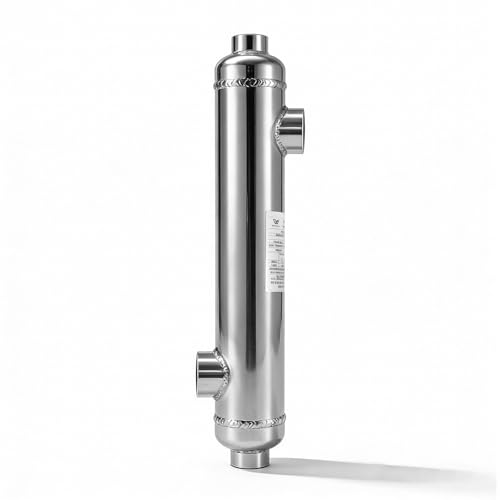
If you’re dealing with a large saltwater pool or a commercial aquaculture setup, this AB titanium heat exchanger is built to handle the tough stuff. The big selling point is the 99.99% purity titanium construction with titanium filler welding, which means it won’t corrode from high chlorine, salt water, or even seawater.
It’s rated for up to 600 kBtu/hr, so it can heat a 47,500-gallon pool efficiently, especially with a 140°F temperature difference. I appreciate the same-side port design with 2 1/2″ FPT for pool water and 2″ FPT for hot water, which simplifies plumbing in tight mechanical rooms.
The precision manual welding feels premium and gives you confidence it won’t leak. This is for someone who needs serious corrosion resistance and high output, not a casual homeowner with a small above-ground pool.
The main drawback is the price and size — it’s an investment and physically large, so it’s overkill for standard residential pools. Also, you’ll need a robust boiler or heat source to actually reach those high BTU ratings.
✓ Reasons to Buy
- Pure titanium construction resists salt and chlorine corrosion.
- High 600 kBtu/hr capacity for large pools or industrial use.
- Same-side ports simplify plumbing in tight spaces.
- Precision manual welding ensures a leak-proof seal.
- Lightweight titanium is easier to handle than steel alternatives.
✗ Reasons Not to Buy
- Expensive and overkill for small residential pools.
- Requires a high-output boiler to reach full capacity.
- Large physical size needs ample installation space.
Mishimoto MMRAD-HE-02 Universal Air-to-Water Heat Exchanger

If you’re building a high-horsepower project car and need to keep your intake air temps in check, the Mishimoto MMRAD-HE-02 is a solid choice. This universal air-to-water heat exchanger is built for serious power, handling up to 750 hp with ease.
The 3-row core is strategically designed to balance flow and heat dissipation, so it actually works under sustained boost, not just on a dyno pull. The core size is 25.98 x 7.81 x 2.04 inches, which is substantial but still manageable for most custom fab setups.
Mishimoto backs it with a lifetime warranty, which tells you they trust their build quality. I’d recommend this to anyone piecing together a high-performance intercooler system for a turbo or supercharged build—especially if you’re tracking the car or pushing big power daily.
The main downside is the price; it’s not cheap compared to generic bar-and-plate coolers, and for a budget build, you might be better off with a more affordable option that still gets the job done.
✓ Reasons to Buy
- Handles up to 750 hp easily.
- Lifetime warranty gives peace of mind.
- 3-row core design maximizes cooling efficiency.
- Universal fit works for custom builds.
- Durable construction for track use.
✗ Reasons Not to Buy
- Expensive compared to generic options.
- No mounting brackets included.
AB 4×12 30 Plate Brazed Heat Exchanger Copper/SS316L

This AB Plate Heat Exchanger is a workhorse for hydronic heating and domestic hot water systems. It’s built with 316L stainless steel plates brazed together with 99.9% copper, making it tough against leaks and high pressure.
With 30 plates in a 4×12 inch footprint, it cranks out 250,000 to 330,000 BTU per hour, which is plenty for floor heating, snow melting, or a wood boiler setup. The 1-inch MPT threads make hookup straightforward, and since it’s a passive heat exchanger, it runs without electricity or oxygen consumption—great for off-grid or energy-conscious installations.
I’d recommend this to anyone setting up a radiant floor system or needing to transfer heat from a wood stove to a storage tank. The compact size is a bonus for tight mechanical rooms.
The catch is that copper brazed units can be sensitive to aggressive water chemistry; if your system has high acidity or chlorides, you might see corrosion over time, so check your water quality before installing.
✓ Reasons to Buy
- High BTU output for its compact size.
- 316L stainless steel resists corrosion well.
- No electricity needed for operation.
- Easy to plumb with 1-inch MPT threads.
- Versatile for many hydronic applications.
✗ Reasons Not to Buy
- Copper brazing can corrode in aggressive water.
- Not ideal for potable water in some areas.
HCHCSPEED 2 Row Universal Aluminum Air to Water Intercooler
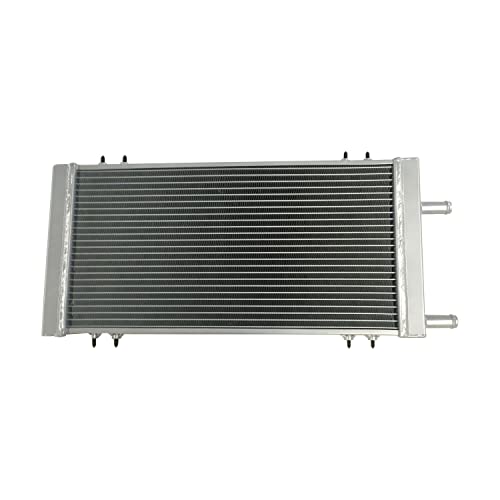
If you’re into custom car builds or upgrading your ride’s cooling system, this HCHCSPEED universal aluminum intercooler is a solid budget pick. It’s built from full aluminum construction, which keeps it lightweight and rust-resistant, and the 258mm by 485mm core offers a decent surface area for air-to-water heat exchange.
I like that it’s designed to fit a wide range of universal models, so you’re not locked into a specific vehicle. Installation is straightforward if you’re handy with hoses and brackets.
Who should buy it? DIY mechanics who need a no-frills, affordable intercooler for a project car or a replacement.
The big downside here is the lack of specific fitment information—you’ll probably need to fabricate your own mounting brackets and adapters, which can be a hassle if you’re not experienced. Also, the 19mm inlet/outlet is on the smaller side, so it might restrict flow in high-performance applications.
Overall, it gets the job done for the price, but don’t expect a plug-and-play experience.
✓ Reasons to Buy
- Lightweight all-aluminum build resists corrosion.
- Universal fit works with many custom builds.
- Decent core size for moderate heat loads.
- Very affordable compared to brand-name options.
✗ Reasons Not to Buy
- No specific vehicle fitment—requires custom brackets.
- Small 19mm ports may limit high-flow setups.
- Basic construction lacks epoxy coating for longevity.
VEVOR 16×16 3-Row Copper Port Water to Air Heat Exchanger

This VEVOR water-to-air heat exchanger is a beast for workshop or garage heating setups. The 16×16 inch face with 193 aluminum fins gives you a huge surface area for dumping heat, and it cranks out up to 160 kBtu per hour—plenty for heating a large space with a wood boiler or solar system.
I’m impressed by the build quality: copper brazed edges and epoxy-coated fins mean it’s leak-resistant and can handle corrosion from condensation. The 3/8-inch copper tubes in three rows provide efficient heat transfer without choking flow.
Who should buy it? Homeowners with outdoor furnaces, or anyone building a radiant heating system who wants a reliable, high-capacity unit.
The main con is the size—it’s bulky and heavy, so mounting it requires solid framing. Also, while the epoxy coating helps, the fins are still delicate and can bend easily if you’re rough during installation.
For the price, though, you’re getting commercial-grade performance without the markup.
✓ Reasons to Buy
- High 160 kBtu output heats large spaces fast.
- Epoxy-coated fins resist corrosion and scaling.
- Copper brazed construction is leak-proof and durable.
- Large 16×16 area maximizes heat exchange efficiency.
✗ Reasons Not to Buy
- Heavy and bulky—needs strong mounting support.
- Delicate fins bend easily if handled carelessly.
- No mounting brackets included for easy installation.
Outdoor Furnace Supply 24″ Side Arm Heat Exchanger

This is a 24-inch side arm heat exchanger designed for outdoor furnaces and boilers, and it’s about as straightforward as it gets. If you have a wood or coal boiler outside and need to transfer that heat into your home’s hydronic system, this unit does the job with no unnecessary complexity.
It’s built for durability, with a sweat connection that plumbers will appreciate for a solid, leak-free install. The side arm design is space-efficient and easy to retrofit into an existing setup.
Who should buy it? Anyone who wants a reliable, no-frills solution for adding heat exchange capacity without messing with electronics or pumps.
The real downside is the lack of included insulation—if you’re running it outdoors or in an unheated space, you’ll need to wrap it yourself to avoid losing heat to the air. Also, the finish is purely functional; it’s not pretty, but it works.
✓ Reasons to Buy
- Simple sweat connections for easy plumbing installation.
- Rugged construction built for outdoor furnace environments.
- Compact side arm design saves valuable space.
- No electronics or moving parts to fail.
- Affordable option for basic heat exchange needs.
✗ Reasons Not to Buy
- No included insulation for heat loss prevention.
- Bare metal finish may rust if not painted.
VEVOR EATB28-30 5×12 30 Plate Brazed Heat Exchanger

The VEVOR brazed plate heat exchanger is a compact powerhouse for anyone needing serious heat transfer in a small package. With 30 plates in a 5×12 inch footprint, it packs up to 360,000 BTU per hour of capacity, making it perfect for hydronic heating, solar thermal, or even radiant floor systems.
The construction is top-notch: 316L stainless steel plates with 99% copper brazing that’s vacuum-brazed and helium leak-tested, so you won’t get micro-leaks down the line. I love the included 304 stainless steel brackets—they make mounting solid and rust-resistant.
The asymmetrical herringbone pattern creates turbulence for up to 99% heat efficiency, which means you save on pump energy. Who should buy it?
DIYers or pros building a high-efficiency system who want a certified, leak-proof unit at a fair price. The catch?
The copper brazing means you can’t use it with ammonia or certain aggressive chemicals—stick to water or glycol. Also, the connections are sweat or threaded, so you’ll need proper adapters if your system uses PEX.
✓ Reasons to Buy
- High 260-360K BTU capacity in a small form.
- 316L stainless steel with 99% copper brazing is durable.
- Helium leak tested for zero micro-leaks.
- Includes sturdy 304 stainless steel mounting brackets.
- UL and CE certified for reliable quality.
✗ Reasons Not to Buy
- Copper brazing not compatible with ammonia systems.
- Requires adapters for non-sweat or threaded connections.
Product prices and availability are accurate as of the date/time indicated and are subject to change. Any price and availability information displayed on Amazon.com at the time of purchase will apply to the purchase of this product.
Buying Guide
FAQs
What should I look for when choosing between a heat exchanger and a dual boiler system?
For pool or hydronic heating, a heat exchanger is simpler and more efficient if you already have a boiler or wood stove as a heat source. A dual boiler system is better if you need two independent temperature zones, like for a domestic hot water tank and a radiant floor loop, without cross-contamination.
How does the AB 300 kBTU compare to the VEVOR Pool Heat 210K BTU for a saltwater pool?
The AB 300 kBTU is built with 316L stainless steel and is rated for up to 23,800 gallons, making it suitable for chemical-treated freshwater pools. For a saltwater pool, the AB 600kBtu Titanium is a much better choice because it uses 99.99% pure titanium, which resists corrosion from chlorine and salt far better than 316L stainless steel.
Which water-to-air heat exchanger is better for a forced air furnace: the 20×20 or the VEVOR 16×16?
The 20×20 Heat Exchanger uses a 306 steel case and 3 rows of copper tubes with aluminum fins, producing higher BTU output for larger spaces. The VEVOR 16×16 is a solid option for smaller plenums, but its epoxy-coated fins are more corrosion-resistant in humid environments, so it may last longer in a damp basement setup.
Is the AB Plate Heat Exchanger or the VEVOR Brazed Plate better for a home radiant floor system?
Both are 30-plate 316L stainless steel units, but the VEVOR Brazed Plate has a slightly higher BTU range (260-360K) and features an asymmetrical herringbone pattern for better turbulence and efficiency. The AB Plate is a reliable, slightly cheaper alternative if you need 250-330K BTU and don’t require the extra efficiency margin.
What size heat exchanger do I need for a 15,000-gallon pool?
For a 15,000-gallon pool, aim for a unit with at least 200-300 kBTU/hr output, like the VEVOR Pool Heat 210K BTU or the AB 300 kBTU. Oversizing slightly reduces heat-up time, but undersizing will struggle to maintain temperature in cooler weather. Always match the flow rate of your pump to the exchanger’s specifications.
Can I use a water-to-air heat exchanger like the Mishimoto MMRAD-HE-02 for a home heating system?
The Mishimoto MMRAD-HE-02 is designed for air-to-water intercooler systems in high-performance vehicles, not for home hydronic heating. Its 3-row core is optimized for charge-air cooling up to 750 hp, and it lacks the corrosion resistance and port sizing needed for residential boiler water or pool applications.
What are the pros and cons of a side arm heat exchanger like the 24″ Side Arm for a domestic hot water tank?
A side arm heat exchanger is simple and inexpensive for adding a wood boiler to an existing hot water tank, using natural convection to circulate water. The downside is that it relies on the tank’s temperature difference, so it heats slowly and is less efficient than a brazed plate unit, which can transfer heat much faster with a small pump.
Should I choose a copper or stainless steel heat exchanger for a closed-loop radiant floor system?
For a closed-loop system with treated water and no oxygen ingress, a copper tube unit like the VEVOR 16×16 or 20×20 works well and offers high thermal conductivity. However, if there’s any risk of corrosive chemicals or glycol breakdown, go with a 316L stainless steel brazed plate exchanger, as it resists pitting and lasts longer in aggressive conditions.