Comparison: Japanese Knives Best Cutting Board (Updated | Aug 12th)
When it comes to keeping your prized Japanese knives in top shape, your choice of cutting board matters more than you might think. These precision tools deserve a surface that protects their razor-sharp edges while making prep work a joy. But with so many options—wood, plastic, bamboo—how do you know which one’s truly best? We’ve tested the most popular boards side by side to find out which ones honor your knife’s craftsmanship, feel great under your hand, and stand up to daily use without skipping a beat. Let’s dive in.
- Best for premium large hinoki: Shun Cutlery Large Hinoki Cutting Board
- Best for compact hinoki classic: Shun Hinoki Cutting Board – Medium – 15.75″ x 10.75″ x 0.5″
- Best for synthetic edge guard: Yoshihiro Hi Soft High Performance Professional Grade Cutting Board Japanese Sashimi Chef’s Tool Made in Japan (Large)
- Best for mini hinoki board: Shun Cutlery Small Hinoki Cutting Board
- Best for medium synthetic shield: Yoshihiro Hi Soft High Performance Professional Grade Cutting Board Japanese Sashimi Chef’s Tool Made in Japan (Medium)
- Best for authentic hinoki craft: Yoshihiro Hinoki Cypress Cutting Board
- Best for kyoto small hinoki: YAMASAN KYOTO UJI Japanese Hinoki Cutting Board – Small – Natural Cypress Wood Cutting Board
- Best for reversible hinoki slim: BOUMBI Hinoki Wood Reversible Cutting Board (17.3 x 9.8 x 0.55 Inch_Slim Large)
- Best for colour‑coded set: Joseph Joseph Folio Icon 8-Piece Colour coded Cutting Board Set with Japanese Stainless Steel Knives
- Best for multi‑colour board set: Joseph Joseph Folio Icon 8-Piece Multi Colour coded Cutting Board Set with Japanese Stainless Steel Knives
Product Comparison: Japanese Knives Best Cutting Board
Shun Cutlery Large Hinoki Cutting Board, 17.75″ x 11.75″ Large Wooden Japanese Chopping Board for Kitchen, Medium-Soft Wood Preserves Knife Edges, Forest Stewardship Council Certified

When you invest in high-end Japanese cutlery, the last thing you want to do is dull that laser-sharp edge on a hard plastic or bamboo surface. The Shun Cutlery Large Hinoki Cutting Board stands out because it treats your knives with genuine respect. Hinoki is a medium-soft cypress that offers a distinct “give” when the blade strikes, effectively absorbing the impact rather than resisting it. In real-life kitchen prep, this means your expensive Shun or Global knives stay sharper for significantly longer periods between sharpenings.
I would recommend this specific 17.75-inch model to the home cook who actually uses their kitchen for full-meal prep. It’s large enough to handle a pile of mirepoix without everything falling off the edges, and it doubles beautifully as a rustic charcuterie board. It’s a Forest Stewardship Council certified choice, which adds peace of mind for those of us trying to shop sustainably.
The honest trade-off here is the maintenance. Hinoki is a soft wood, which makes it prone to staining and deep scratches if you aren’t careful. You have to remember to dampen the board before every single use to seal the fibers, and you absolutely cannot skip the hand-washing routine. If you’re a “throw it in the dishwasher” type of person, this board will warp and ruin your day very quickly.
Shun Hinoki Cutting Board – Medium – 15.75″ x 10.75″ x 0.5″

The Shun Hinoki Cutting Board in Medium is the “Goldilocks” of the lineup. It offers that legendary Japanese cypress softness that protects your blades, but in a 15.75-inch footprint that doesn’t take over your entire countertop. What makes this stand out is how it feels under the knife; there is a certain tactile thump that is much more satisfying than the clicky, jarring feedback you get from standard poly boards. It’s a sensory experience, aided by the subtle, clean fragrance of the wood itself.
This is the best choice for a daily driver in a standard-sized kitchen. It’s big enough for a large onion or a bunch of kale, yet slim enough at 0.5 inches thick to slide into a drawer or a narrow cabinet slot. If you have a single high-quality Japanese chef’s knife and want to maintain its factory edge without the bulk of a heavy butcher block, this is your winner.
However, the 0.5-inch thickness is a double-edged sword. While it’s lightweight and easy to handle, it is much more susceptible to warping than thicker boards. You have to be incredibly diligent about air-drying it upright and away from heat sources. It’s a delicate piece of equipment, not a heavy-duty workhorse you can leave soaking in a damp sink.
Yoshihiro Hi Soft High Performance Professional Grade Cutting Board Japanese Sashimi Chef’s Tool Made in Japan (Large)

If you’ve ever watched a professional sushi chef at work, you’ve likely seen a board like the Yoshihiro Hi Soft High Performance surface. This isn’t wood; it’s a sophisticated synthetic material specifically engineered for high-carbon steel knives. What makes it incredible in practice is the “rebound” it provides. It’s soft enough that your blade slightly sinks into the surface, which prevents the edge from rolling or chipping—a common tragedy with hard Japanese steels. It’s a tool built for precision, particularly for Sashimi and delicate slicing.
This “Large” version (nearly 20 inches long) is for the serious enthusiast or the pro who needs ample space for long, single-stroke pulls with a Yanagiba. It’s for the person who prioritizes performance and blade longevity over the aesthetics of a wooden board. It’s also much more hygienic and odor-resistant than wood, making it a dream for working with raw fish or proteins.
The downside is purely aesthetic: it looks like a piece of industrial equipment. It lacks the warmth and beauty of Hinoki, and because it is a “soft” synthetic, it will show deep knife tracks over time. It’s a professional-grade tool meant for work, not a display piece to leave out when guests come over for wine and cheese.
Shun Cutlery Small Hinoki Cutting Board, 10.75″ x 8.25″ Small Wooden Japanese Chopping Board for Kitchen, Medium-Soft Wood Preserves Knife Edges, Forest Stewardship Council Certified
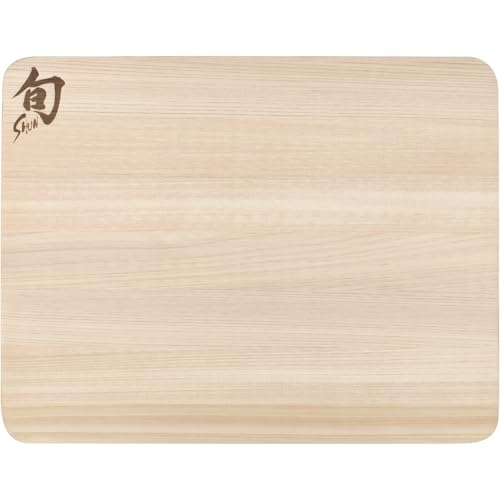
The Shun Cutlery Small Hinoki Cutting Board is the specialist of the family. Despite its 10.75-inch size, it carries the same Japanese craftsmanship and blade-saving properties as its larger siblings. In a real kitchen environment, this board stands out for its convenience. It’s the one you grab for the small, annoying tasks—slicing a single lemon for a cocktail, mincing a couple of garlic cloves, or dicing a shallot—without having to haul a massive wooden slab to the counter.
I see this as the perfect companion board for someone who already owns a large workspace but needs a “satellite” board for quick tasks. It’s also an excellent entry point for someone who just bought their first high-end paring knife and wants to see what the Hinoki hype is about without a major investment. Its compact size makes it a favorite for apartment dwellers with limited counter real estate.
The trade-off is obviously the utility. You cannot comfortably chop a head of cabbage or carve a roast on this; it’s simply too small. You’ll find yourself constantly chasing ingredients off the edge if you try to do any significant prep. It’s a “sidekick” board, not a “hero” board, and you have to be okay with its very limited surface area.
Yoshihiro Hi Soft High Performance Professional Grade Cutting Board Japanese Sashimi Chef’s Tool Made in Japan (Medium)
The Yoshihiro Hi Soft Medium board brings professional-grade Japanese technology into a size that actually fits a residential kitchen. While wood is traditional, this high-quality synthetic material is arguably the “best” surface for edge retention on the market. It feels almost rubbery but remains firm enough for stable cuts. In real life, the standout feature is the lack of “blade bounce”—the material absorbs the energy of the strike, which significantly reduces hand and wrist fatigue during long prep sessions.
This is the ideal purchase for the home cook who has graduated to expensive Aogami or Shirogami carbon steel knives. These knives are notoriously brittle on hard surfaces, and this board acts as an insurance policy against micro-chipping. Because it’s 0.8 inches thick, it feels much more substantial and premium than the thinner Shun boards.
The honest catch is the price and the weight. For a synthetic board, Yoshihiro asks a premium, and it’s surprisingly heavy for its size. It’s also worth noting that the soft surface can “grip” the blade a bit too much if you’re used to sliding your knife across the board, which might require a slight adjustment to your cutting technique.
Yoshihiro Hinoki Cypress Cutting Board, Japanese Hinoki Wood, Knife Friendly, Professional Grade (X-Large)
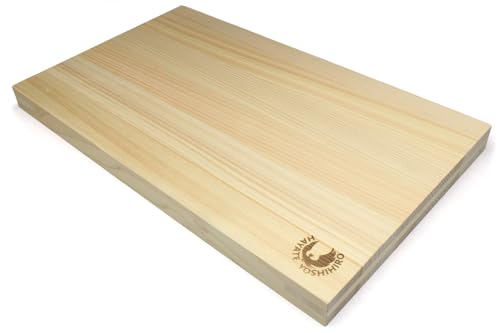
The Yoshihiro Hinoki Cypress Cutting Board is a significant step up from standard wood boards because of its clever construction. While many hinoki boards are just single slabs, this one features a Maple anti-twist core. This is a game-changer in real-world use because it addresses the number one complaint about hinoki: warping. You get the soft, fragrant, blade-protecting exterior of Japanese cypress with the structural integrity of a much harder wood at its center.
I would recommend this to the “serious” home chef who wants an authentic Japanese aesthetic but doesn’t want to baby their board quite as much as a thin, solid-slab version requires. At 2.5cm (about an inch) thick, it has a professional-grade presence on the counter. It’s the kind of board you buy once and keep for a decade if you treat it right.
The trade-off here is the weight and the footprint. The X-Large size is quite bulky, and because of the multi-wood construction, you have to be even more careful about not leaving it submerged in water, as the different woods might expand at different rates. It’s a high-maintenance beauty that demands a dedicated spot on your counter because you won’t want to move it often.
YAMASAN KYOTO UJI Japanese Hinoki Cutting Board – Small – Natural Cypress Wood Cutting Board, Kitchen Chopping Board, High Durability, Made in Japan (14.17×8.66×0.59 inch) (Small)

The YAMASAN KYOTO UJI Japanese Hinoki Cutting Board is as minimalist as it gets. This is a no-frills, natural cypress board made in Japan that prioritizes the wood’s inherent qualities over fancy branding. What stands out is the purity of the material; the scent is immediately noticeable, providing a spa-like aroma to your kitchen. It’s thin, lightweight, and does exactly what hinoki is supposed to do: protect your knives with its soft, yielding grain.
This is the best choice for the budget-conscious shopper who wants an authentic Japanese-made product without the “brand tax” of larger names. It’s a great utility board for light tasks like slicing fruit or preparing small garnishes. If you are tight on space and need something that can be tucked away in a dish rack easily, the Small dimensions are perfect.
However, the downside is the lack of “features.” Unlike the Yoshihiro, it has no anti-warp core, and unlike the Shun, it isn’t specifically treated for high-volume commercial aesthetics. It is a very basic, thin piece of wood that is highly prone to staining and bowing if it isn’t dried perfectly. It feels a bit more “disposable” than the heavier professional boards on this list.
BOUMBI Hinoki Wood Reversible Cutting Board (17.3 x 9.8 x 0.55 Inch_Slim Large)
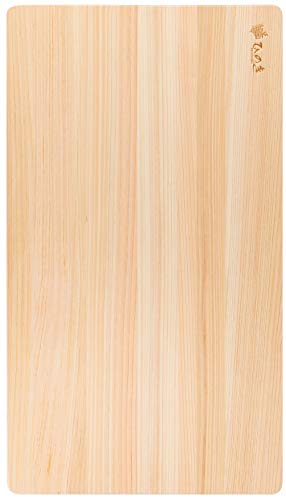
The BOUMBI Hinoki Wood Reversible Cutting Board takes a high-tech approach to a traditional material. While most hinoki comes from Japan, this is sourced from natural forests in Korea and processed using a high-frequency vacuum drying chamber. In real life, this results in a wood that feels more stable and “settled” than some of the air-dried alternatives. The joined-piece construction is another standout feature, designed specifically to fight the warping and splitting that plagues solid hinoki slabs.
This is a great middle-ground board for someone who wants the aroma and softness of cypress but lives in a climate with fluctuating humidity that might wreck a solid board. It’s slim and “Slim Large” in its dimensions, making it a very agile board for a busy cook who is constantly moving things around the kitchen. It’s reversible, too, which is great for separating veggies from cooked meats.
The trade-off is that it’s not a single piece of wood. For purists, the joined pieces (edge-grain style) might not have the same visual prestige as a single, wide plank of hinoki. There are more glue lines, which technically means more points of potential failure over many years, though the vacuum technology is meant to mitigate this.
Joseph Joseph Folio Icon 8-Piece Colour coded Cutting Board Set with Japanese Stainless Steel Knives, Slimline case for organized storage, Graphite

The Joseph Joseph Folio Icon 8-Piece Set is a completely different animal than the traditional Japanese slabs. This is a system designed for organization and hygiene. What stands out is the sheer convenience: four color-coded boards and four Japanese stainless steel knives all tucked into a slim, graphite-colored case. In a small kitchen or an apartment where counter space is a premium, this set is a masterclass in efficiency. The boards have non-slip feet and “knife-friendly” textures, which is a nice touch for a plastic surface.
This is the perfect gift for someone starting a new kitchen or a student who needs a “complete” setup in one box. It’s for the cook who hates cross-contamination and loves an organized, clutter-free aesthetic. The integrated tool rests on the knives are a clever real-life feature, keeping your messy blades off the countertop.
The honest trade-off is the quality of the “Japanese” element. While the steel is Japanese, these are mass-produced knives that won’t hold a candle to a handcrafted Shun or Yoshihiro. Similarly, the plastic boards are “knife-friendly” but will never offer the edge-preservation of real Hinoki or Hi-Soft material. You are paying for the organization system, not world-class cutlery performance.
Joseph Joseph Folio Icon 8-Piece Multi Colour coded Cutting Board Set with Japanese Stainless Steel Knives, Slimline case for organized Kitchen storage, Silver

The Joseph Joseph Folio Icon in Silver offers the same high-efficiency organization as the Graphite version but with a more vibrant, multi-color palette. What makes this set stand out in a busy household is the color-coding. It removes the guesswork—red for meat, blue for fish, green for veggies—making it much safer for families concerned about foodborne illness. The slimline case is surprisingly stylish and does a great job of hiding the “clutter” of multiple boards and loose knives.
This is the best use case for a casual cook who values hygiene and ease of cleaning above all else. Since the boards are plastic, they can go right into the dishwasher, which is a luxury you don’t get with any of the premium wood boards. If you want a “Japanese-style” edge (Santoku included) but need the ruggedness of modern materials, this fits the bill.
The downside is the durability of the boards themselves. Because they are relatively thin and made of plastic, they will develop deep scars and “fuzz” from sharp knives much faster than a thick wooden block. Also, the 6.5-inch chef’s knife is a bit small for heavy-duty tasks like breaking down a whole chicken or slicing a large watermelon. It’s a “light-duty” set disguised as a professional system.
Product prices and availability are accurate as of the date/time indicated and are subject to change. Any price and availability information displayed on Amazon.com at the time of purchase will apply to the purchase of this product.
Buying Guide
FAQs
What material is best for preserving the edge of a Japanese knife?
Soft woods like Hinoki Cypress are ideal because they give slightly under the blade, reducing edge wear. Synthetic boards such as Yoshihiro’s Hi‑Soft also protect blades while offering odor resistance. Both options are gentler than hard hardwoods like maple.
How do the Shun Hinoki boards differ from the Yoshihiro Hi‑Soft boards?
Shun boards are made from natural Hinoki wood, offering a pleasant fragrance and a traditional look, while Yoshihiro’s Hi‑Soft boards use a high‑performance synthetic material that resists staining and odor. The Shun boards are double‑sided and vary in size, whereas the Hi‑Soft boards focus on ergonomic thickness for hand comfort. Price points reflect the natural wood versus engineered material.
Which size cutting board should I choose for everyday home cooking?
A medium‑sized board (around 15‑17 inches long) like the Shun Medium Hinoki or Yoshihiro Medium Hi‑Soft provides enough surface for most prep tasks without taking up too much storage space. If you often work with larger items or multiple dishes, the large Shun Hinoki (17.75″ x 11.75″) offers extra room. Smaller boards are convenient for limited countertops or quick tasks.
Do I need to treat or maintain a Hinoki cutting board differently than a synthetic one?
Hinoki boards should be lightly dampened before each use, cleaned with mild detergent, towel‑dried, and air‑dried away from direct sunlight; occasional lemon rubs help remove stains. Synthetic Hi‑Soft boards can be washed with warm soapy water and do not require oiling or special drying. Both benefit from regular cleaning to prevent bacterial buildup.
Is the price difference between Shun and Yoshihiro boards justified?
Shun’s Hinoki boards command a premium due to the sustainably sourced Japanese cypress and handcrafted quality, which many chefs value for aesthetics and aroma. Yoshihiro’s synthetic boards are priced lower but deliver comparable blade protection and added features like odor resistance. Your choice depends on whether you prioritize natural material and visual appeal over cost efficiency.
Can I use the same cutting board for both meat and vegetables without cross‑contamination?
Yes, especially with double‑sided boards like Shun’s, you can designate one side for raw proteins and the other for produce. Synthetic boards such as Yoshihiro’s Hi‑Soft are non‑porous and resist odor absorption, making them easy to sanitize between uses. Always clean thoroughly after handling raw meat to maintain food safety.
What are the benefits of a reversible cutting board?
A reversible board doubles your usable surface area, allowing you to switch sides for different tasks or to extend the board’s lifespan by rotating wear. Both Shun Hinoki and many synthetic boards offer this feature, which is handy in busy kitchens. It also helps keep cross‑contamination in check when you assign each side a specific food type.
How important is the board’s thickness for comfort and durability?
Thicker boards (around 0.8‑2.5 cm) provide a stable, less flexing surface, reducing hand fatigue during prolonged chopping. Yoshihiro’s Hi‑Soft boards are 0.8 cm thick and engineered for ergonomic comfort, while Shun Hinoki boards range from 0.5 cm to 0.8 cm, offering a lighter feel. Choose thickness based on your cutting style and countertop space.