Comparison: Best Cutting Board Japanese (Updated | Aug 8th)
When it comes to kitchen essentials, a great cutting board can make all the difference—and Japanese craftsmanship has long set the gold standard. From sleek, minimalist designs to ultra-durable materials like hinoki and end-grain wood, Japanese cutting boards blend beauty, function, and tradition. But with so many options out there, how do you choose the best one for your kitchen? We’ve tested and compared top picks to help you find the perfect balance of performance, longevity, and style—because every home chef deserves a board they’ll love using every day.
- Best for fragrant hinoki medium: Shun Hinoki Cutting Board – Medium – 15.75″ x 10.75″ x 0.5″
- Best for synthetic edge saver: Yoshihiro Hi Soft High Performance Professional Grade Cutting Board Japanese Sashimi Chef’s Tool Made in Japan (Medium)
- Best for large hi-soft surface: Yoshihiro Hi Soft High Performance Professional Grade Cutting Board Japanese Sashimi Chef’s Tool Made in Japan (Large)
- Best for grand hinoki elegance: Shun Cutlery Large Hinoki Cutting Board
- Best for durable rubber board: Asahi Cookin Cut Rubber Cutting Board
- Best for compact hinoki charm: YAMASAN KYOTO UJI Japanese Hinoki Cutting Board – Small – Natural Cypress Wood Cutting Board
- Best for dishwasher safe rubber: Kitchen Star Tsukihoshi Rubber Cutting Board Made in Japan
- Best for titanium chef’s edge: HIBINO Titanium Cutting Board | 99.5% Pure Japanese Titanium | Non-Toxic | Lightweight & Dishwasher Safe | L Size | Made in Japan | With Non-Slip Mat | For Kitchen & Camping Use
- Best for large rubber durability: Asahi Cookin Cut Rubber Cutting Board
- Best for medium rubber reliability: Asahi Cookin Cut Rubber Cutting Board
Product Comparison: Best Cutting Board Japanese
Shun Hinoki Cutting Board – Medium – 15.75″ x 10.75″ x 0.5″

If you have ever felt the soul-crushing sensation of a hard bamboo board dulling your expensive Japanese steel, the Shun Hinoki Cutting Board (Medium) is the antidote. What makes this board stand out in a real kitchen is the hinoki wood itself. It’s a Japanese cypress that feels almost “soft” under the blade. When you chop, the wood fibers give way slightly, which means your knife edge stays sharp for significantly longer. Plus, the natural fragrance is incredible—it releases a subtle, clean forest scent the moment it gets damp.
I’d recommend this specifically for home cooks who own high-end Damascus or carbon steel knives and want to maintain that razor edge without constant honing. At 15.75 inches, it’s the “Goldilocks” size—large enough for a pile of mirepoix but small enough to fit in a standard cupboard. It’s a beautiful piece of craftsmanship that doubles as a serving platter for cheese or sushi.
The honest trade-off here is the high maintenance. Hinoki is a soft, porous wood. If you don’t wet it thoroughly before every single use, it will soak up beet juice or garlic smells like a sponge. It’s also prone to warping if you don’t air-dry it perfectly, so it’s definitely not a “toss it in the sink and forget it” kind of tool.
Yoshihiro Hi Soft High Performance Professional Grade Cutting Board Japanese Sashimi Chef’s Tool Made in Japan (Medium)

The Yoshihiro Hi Soft (Medium) is essentially the industry standard for sushi chefs for a reason. What really sets it apart in a professional or high-volume setting is the polyvinyl acetate material. It’s designed to mimic the “give” of wood while offering the hygiene of a synthetic. When you’re doing delicate work like slicing sashimi, the blade feels like it’s sinking into a cloud rather than hitting a wall. This lack of resistance is what saves your wrist from fatigue over a long afternoon of prep.
This is the best choice for the serious enthusiast or professional who uses high-carbon steel knives that are prone to chipping on harder surfaces. If you’ve invested hundreds of dollars in a Yoshihiro or similar brand, this board is the insurance policy for that investment. It’s 0.8 inches thick, giving it a sturdy, premium heft that won’t slide around your counter.
However, the downside is the aesthetic and price. For what is essentially a high-tech piece of plastic, it’s quite expensive, and it doesn’t have the rustic beauty of a wooden board. It also shows knife scars quite easily because the material is so soft, so don’t expect it to stay looking pristine for long if you’re doing heavy chopping.
Yoshihiro Hi Soft High Performance Professional Grade Cutting Board Japanese Sashimi Chef’s Tool Made in Japan (Large)
Stepping up to the Yoshihiro Hi Soft (Large) gives you a massive 19.6-inch canvas that completely changes how you organize your station. In real-life use, that extra real estate means you aren’t constantly clearing off your board into bowls; you can just push your chopped aromatics to the corner and keep working. The High Performance Synthetic material provides a unique “rebound” that protects the microscopic edge of professional-grade cutlery, ensuring your Sashimi Chef’s Tool stays sharp through an entire dinner service.
This size is best suited for serious home cooks with large countertops or professional chefs who need the space for breaking down large proteins or handling bulk produce. It’s the ultimate surface for high-carbon steel because it minimizes the impact shock that causes micro-chipping. If you find yourself frustrated by cramped boards, this is the upgrade you need.
The obvious trade-off is the sheer footprint. At nearly 20 inches long, this board won’t fit in most standard dish racks or small sinks, making the cleaning process a bit of a localized workout. It’s also quite heavy, so it’s less of a “grab and go” board and more of a permanent fixture on your prep station.
Shun Cutlery Large Hinoki Cutting Board, 17.75″ x 11.75″ Large Wooden Japanese Chopping Board for Kitchen, Medium-Soft Wood Preserves Knife Edges, Forest Stewardship Council Certified

The Shun Cutlery Large Hinoki Cutting Board is the big brother of the hinoki line, and its presence in the kitchen is undeniable. What stands out most is the Forest Stewardship Council certified wood quality; it’s sustainable, lightweight for its size, and possesses natural antibacterial properties. The 17.75-inch surface provides enough room to handle a large roast or a mountain of greens, and the medium-soft wood grain ensures that your Shun knives—or any fine cutlery—don’t lose their bite after just one meal.
I would suggest this for entertainers and holiday cooks. Because it’s so visually striking and smells so pleasant, it’s the perfect board to transition from the kitchen counter to the dining table as a large charcuterie board. It’s for someone who values the ritual of cooking and doesn’t mind the extra care wood requires.
The catch is that hinoki is quite soft compared to maple or walnut. While this is great for your knives, the board itself will develop deep “character lines” (scratches) very quickly. It’s also thin at 0.5 inches, so without proper care and regular flipping, a board this large is susceptible to bowing or warping over time if it stays damp on one side.
Asahi Cookin Cut Rubber Cutting Board, NE05103, Home Use, Made in Japan LL 16.5 x 9.8 x 0.5 inches (42cm x 25cm x 1.3cm)

The Asahi Cookin Cut (LL) is a bit of a cult favorite among those who want the performance of a professional Japanese kitchen without the fuss of wood. What makes this stand out is the synthetic rubber construction. It has a very high density that feels remarkably like wood under the knife, but it’s completely non-porous. It doesn’t absorb liquids, it doesn’t harbor bacteria, and it dries almost instantly. At 16.5 inches, the LL size provides a generous workspace for home prep.
This is the “workhorse” board for the practical cook who wants Japanese quality but hates the maintenance of hinoki. It’s ideal for handling raw meats and fish because you can sanitize it much more aggressively than a wooden board. If you want a made in Japan tool that can handle heavy daily abuse, this is it.
The trade-off here is that it is not dishwasher safe. Even though it’s rubber, the high heat of a dishwasher can warp it, which is a common misconception. Also, because it’s a tan, functional-looking material, it lacks the “countertop appeal” of a beautiful wood grain; it looks like a piece of commercial equipment, not a kitchen accessory.
YAMASAN KYOTO UJI Japanese Hinoki Cutting Board – Small – Natural Cypress Wood Cutting Board, Kitchen Chopping Board, High Durability, Made in Japan (14.17×8.66×0.59 inch) (Small)

The YAMASAN KYOTO UJI Japanese Hinoki Board is a beautiful, minimalist piece of Kyoto craftsmanship. What stands out in real-life use is the pure cypress aroma and the surprising lightness of the wood. At roughly 14 inches, it’s a smaller, more maneuverable board that feels very intentional. The high durability of the hinoki used here is paired with a natural oil content that helps it resist water better than cheaper softwoods.
This is the perfect choice for apartment dwellers or minimalist cooks who mostly prep small meals, fruits, or garnishes. If you have a small kitchen but still want a “real” Japanese cutting surface that respects your knives, this fits the bill. It’s also an excellent secondary board for quick tasks like slicing a single lemon or a small block of tofu.
However, the small size is a limitation for anyone doing “real” cooking. If you try to chop a bunch of kale or a large onion on this, you’ll likely find ingredients falling off the edges. It’s a specialty tool for precision and small tasks, not a primary board for family-sized meal prep.
Kitchen Star Tsukihoshi Rubber Cutting Board Made in Japan,Dishwasher-Safe Size:13.54×8.38×0.39inches(344×213×10mm) Equipped with a Cutting Board Scraper for Synthetic Rubber Cutting Boards (M)

The Kitchen Star Tsukihoshi Rubber Cutting Board is a clever, modern take on the traditional Japanese rubber board. What makes it stand out is that it’s dishwasher-safe, which is a rarity for high-quality synthetic rubber boards. It also comes with a specialized scraper, acknowledging that these boards do get nicked over time and providing you the tool to smooth the surface back down. The drip-dry efficiency and the marks for distinguishing sides make it very hygienic.
This is the best option for busy home cooks who prioritize food safety and convenience. If you want the “soft touch” that protects your Japanese knives but you refuse to hand-wash your equipment, this is one of the few boards that bridges that gap. The medium size is versatile enough for most daily tasks.
The downside is that at 0.39 inches thick, it’s quite thin. While it has “appropriate weight” as the features suggest, it doesn’t have that solid, chunky feel of a heavy butcher block. Some users might find that it feels a bit “flimsy” on the counter compared to the thicker Asahi or Yoshihiro alternatives, even if it performs well.
HIBINO Titanium Cutting Board | 99.5% Pure Japanese Titanium | Non-Toxic | Lightweight & Dishwasher Safe | L Size | Made in Japan | With Non-Slip Mat | For Kitchen & Camping Use
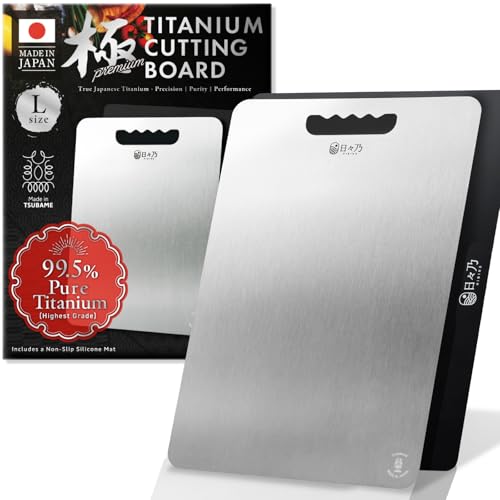
The HIBINO Titanium Cutting Board is a total departure from the wood and rubber world. What makes it stand out is its 99.5% pure Japanese titanium construction. It is incredibly thin (0.04 inches) and lightweight, yet virtually indestructible. In the kitchen, it’s the most hygienic surface possible—it won’t scratch like plastic, won’t harbor bacteria, and won’t hold onto the smell of fish or onions no matter what you do.
I’d recommend this for campers, outdoor enthusiasts, or ultra-hygienic cooks. Since it’s dishwasher safe and rust-proof, it’s the ultimate low-maintenance tool. The XL size is great for big prep, but because it’s so thin, you can slide it into a backpack or a crowded drawer without taking up any space.
The massive trade-off here is the noise and the feel. Unlike hinoki or Hi Soft boards which “absorb” the knife hit, titanium is a hard metal. Even though it claims to be knife-friendly, the “clink-clink” sound of steel on titanium can be jarring for some, and it won’t provide that soft, satisfying “thud” that chefs usually look for in a Japanese board. It’s a tool built for utility and cleanliness over “blade feel.”
Asahi Cookin Cut Rubber Cutting Board, NE05102, Home Use, Made in Japan L 15.7 x 9.1 x 0.5 inches (40cm x 23cm x 1.3cm)

The Asahi Cookin Cut (L) sits right in the sweet spot of the Asahi lineup. What makes it a standout is the professional-grade rubber that feels remarkably similar to a high-end wood board but offers much better odor resistance. It’s 15.7 inches long, which is the standard size most home cooks find comfortable. It provides a stable, non-slip surface that grips the counter, so you never have to worry about the board sliding while you’re working with a sharp blade.
This is the ideal choice for the home chef who wants a “lifetime” board. It’s thick enough (0.5 inches) to be resurfaced with sandpaper if it ever gets too many deep grooves, effectively making it a permanent fixture in your kitchen. It’s especially great for those who handle a lot of proteins, as it’s much easier to sanitize than a wooden board.
The main downside is that the synthetic rubber can be quite heavy and it’s strictly hand-wash only. If you leave it in a hot dishwasher, it will warp and lose its perfectly flat profile. It’s a professional tool that requires a professional level of respect for its temperature limits.
Asahi Cookin Cut Rubber Cutting Board, NE05101, Home Use, Made in Japan M 15.0 x 8.3 x 0.5 inches (38cm x 21cm x 1.3cm)
The Asahi Cookin Cut (M) is the compact version of Japan’s most famous rubber board. What makes it stand out is how it packs professional performance into a 15-inch frame. The synthetic rubber is designed to have a specific “give” that prevents the edge of your knife from rolling or dulling prematurely. It’s a very dense material, meaning it won’t absorb juices from raw meat, making it a much safer alternative to old, scarred plastic boards.
This size is best for people with limited counter space or those who want a dedicated board for specific tasks, like a “meat-only” or “vegetable-only” station. It’s made in Japan to very high standards, and it’s the kind of board that will last for a decade if treated right. It’s for the cook who wants quality but doesn’t need a massive prep area.
The trade-off is simply the size. At 15 inches by 8.3 inches, it can feel a bit narrow if you are used to large Western-style boards. You have to be more disciplined with your “scrap management” to keep the surface clear. Like its larger siblings, it also requires hand-washing to avoid heat damage.
Product prices and availability are accurate as of the date/time indicated and are subject to change. Any price and availability information displayed on Amazon.com at the time of purchase will apply to the purchase of this product.
Buying Guide
FAQs
What are the main material differences between Japanese Hinoki wood boards and synthetic boards?
Hinoki boards, like the Shun and Yamasan models, are made from Japanese cypress, offering a natural fragrance, gentle grain, and a slightly soft surface that protects knife edges. Synthetic boards, such as Yoshihiro Hi Soft and the titanium board, use engineered polymers or metal that are odor‑resistant, dishwasher‑safe, and often more durable under heavy use. Choosing wood gives a classic aesthetic and subtle blade care, while synthetics prioritize low maintenance and high impact resistance.
How does board size influence my kitchen workflow and storage?
Larger boards (e.g., Shun Large Hinoki at 17.75″ x 11.75″ or the XL titanium at 17″ x 12″) provide ample surface for big cuts, whole fish, or charcuterie presentations, but they require more countertop or cabinet space. Medium boards (around 15″–17″ wide) like the Shun Medium Hinoki or Yoshihiro Hi Soft Medium balance versatility and compactness, fitting most drawers. Small boards are ideal for quick prep tasks or limited kitchens, though they may feel cramped for larger ingredients.
Which cutting board offers the best edge‑retention for high‑carbon steel knives?
Boards with a slightly softer surface, such as the Hinoki wood boards and Yoshihiro Hi Soft synthetic boards, allow the blade to glide without excessive wear, preserving edge sharpness. The titanium board is ultra‑thin and knife‑friendly, but its hardness can feel a bit harsher on delicate steel if not used carefully. Overall, the medium‑soft Hinoki and Hi Soft boards are most praised for extending knife life.
Are there hygiene or cleaning advantages to choosing a rubber or titanium board over wood?
Rubber boards (e.g., Asahi Cookin Cut and Kitchen Star Tsukihoshi) and the titanium board are non‑porous, resist water absorption, and are dishwasher‑safe, reducing bacterial buildup. Wooden boards require hand washing, immediate drying, and periodic oiling to prevent staining and warping. If you prioritize low‑maintenance sanitation, synthetic or metal options are the safer choice.
How important is the board’s weight and grip for comfort during long prep sessions?
Heavier boards like the large Hinoki or rubber models provide stability, preventing slipping while you chop. Lighter options, such as the titanium board, often include ergonomic handles or wave‑grip designs to reduce fatigue and improve control. Consider your typical prep duration: a stable, heavier board reduces movement, while a lightweight board with a good grip is easier to maneuver for extended use.
What value does the FSC certification on Hinoki boards add?
Forest Stewardship Council (FSC) certification ensures the wood is sourced from responsibly managed forests, supporting environmental sustainability and legal harvesting practices. This adds a premium feel and ethical assurance, justifying a higher price compared to non‑certified wood or generic synthetic boards. For eco‑conscious shoppers, FSC‑certified Hinoki boards provide both performance and peace of mind.
Should I buy a double‑sided board or a single‑sided board for food safety?
Double‑sided boards, like the Shun Hinoki models, let you designate one side for raw proteins and the other for vegetables, helping prevent cross‑contamination. Single‑sided boards can still be used safely if you clean and sanitize each side thoroughly between tasks. If you often handle raw meat and want a simple visual cue, a double‑sided board adds convenience without extra cost.