Comparison: Best Cutting Board Japan (Updated | Aug 12th)
When it comes to kitchen essentials, few tools matter more than a great cutting board—and Japan has mastered the art. From durable hinoki wood to sleek, knife-friendly plastic, Japanese cutting boards blend tradition, craftsmanship, and functionality like no other. Whether you’re dicing vegetables for ramen or slicing sashimi-grade fish, the right board makes all the difference. In this guide, we’ll compare the top Japanese cutting boards, weighing materials, design, and performance to help you find the perfect fit for your kitchen. Let’s dive in.
- Best for everyday titanium: HIBINO Titanium Cutting Board | 99.5% Pure Japanese Titanium | Non-Toxic | Lightweight & Dishwasher Safe | M Size | Made in Japan | With Non-Slip Mat | For Kitchen & Camping Use
- Best for fragrant hinoki: Shun Hinoki Cutting Board – Medium – 15.75″ x 10.75″ x 0.5″
- Best for elegant cypress: YAMASAN KYOTO UJI Japanese Hinoki Cutting Board – Medium- Natural Cypress Wood Cutting Board
- Best for chef-grade xl: HIBINO Titanium Cutting Board | 99.5% Pure Japanese Titanium | Non-Toxic | Lightweight & Dishwasher Safe | L Size | Made in Japan | With Non-Slip Mat | For Kitchen & Camping Use
- Best for compact titanium: HIBINO Titanium Cutting Board | 99.5% Pure Japanese Titanium | Non-Toxic | Lightweight & Dishwasher Safe | S Size | Made in Japan | With Non-Slip Mat | For Kitchen & Camping Use
- Best for durable rubber: Asahi Cookin Cut Rubber Cutting Board
- Best for knife-friendly synthetic: Yoshihiro Hi Soft High Performance Professional Grade Cutting Board Japanese Sashimi Chef’s Tool Made in Japan (Large)
- Best for heavy-duty rubber: Asahi Cookin Cut Rubber Cutting Board
- Best for petite hinoki: YAMASAN KYOTO UJI Japanese Hinoki Cutting Board – Small – Natural Cypress Wood Cutting Board
- Best for scratch-resistant rubber: Kitchen Star Tsukihoshi Rubber Cutting Board Made in Japan
Product Comparison: Best Cutting Board Japan
HIBINO Titanium Cutting Board | 99.5% Pure Japanese Titanium | Non-Toxic | Lightweight & Dishwasher Safe | M Size | Made in Japan | With Non-Slip Mat | For Kitchen & Camping Use

The HIBINO Titanium Cutting Board in the medium size strikes me as the ultimate modern solution for anyone tired of the “fuzzy” surface that plastic boards develop or the deep scoring of wood. What really makes this stand out is its 99.5% pure Japanese titanium construction. It is incredibly thin at just 0.04 inches, yet it feels indestructible. Because it’s non-porous, it doesn’t hold onto garlic odors or raw meat juices, which is a massive win for hygiene-conscious cooks who want a board that can go straight into the dishwasher without warping.
I’d recommend this specifically for the home cook who values efficiency and space. It’s light enough for camping but sleek enough for a high-end kitchen. The wave-grip handle is a thoughtful touch for moving it around, and it comes with a non-slip mat which is essential since metal on stone or wood counters can be slick.
However, the trade-off here is the auditory experience. While the brand claims it is “knife-friendly,” cutting on metal is never going to feel as soft as wood. You have to be prepared for a clink-clink sound rather than a dull thud, and if you are using extremely expensive, high-hardness Japanese steel, you might find yourself honing your edge a bit more frequently than usual.
Shun Hinoki Cutting Board – Medium – 15.75″ x 10.75″ x 0.5″

There is something deeply traditional and sensory about the Shun Hinoki Cutting Board. Hinoki is a Japanese cypress that produces a delicate natural fragrance when it gets wet, making the prep work feel like a spa experience. What makes this stand out is its “give.” The wood is soft enough that when your blade hits the surface, the fibers compress rather than resist, which is exactly what you want if you own Shun knives or any high-end cutlery. It preserves that razor-sharp edge for much longer than synthetic boards.
This is the best choice for the “knife nerd” or the enthusiast who has invested hundreds of dollars in their blade collection. It’s a medium size (15.75 x 10.75 inches), which is the “Goldilocks” zone for most home kitchens—large enough for a pile of veggies but small enough to fit in a standard cabinet.
The honest downside is the maintenance. Hinoki is a high-maintenance beauty. You must dampen it before use to prevent staining, and it requires careful hand-washing and air-drying away from sunlight. If you are the type to leave a board in the sink overnight, this cypress will warp or crack, and you’ll be heartbroken over the lost investment.
YAMASAN KYOTO UJI Japanese Hinoki Cutting Board – Medium- Natural Cypress Wood Cutting Board, Kitchen Chopping Board, High Durability, Made in Japan (15.35×8.66×0.59 inch) (Medium)

The YAMASAN KYOTO UJI Japanese Hinoki Cutting Board is a straightforward, no-frills entry into the world of traditional Japanese cypress. While it lacks the flashy branding of bigger names, its strength lies in its natural durability and the inherent antibacterial properties of the Hinoki wood. At roughly 15 inches long and over half an inch thick, it provides a sturdy, reliable platform for daily chopping that feels significantly more premium than any plastic alternative.
I think this is the perfect “entry-level” luxury board for someone who wants to try made-in-Japan quality without a massive price tag. It’s best used for vegetable prep and light proteins where you want that soft, cushioned impact that protects your knife’s edge. It brings a bit of Kyoto craftsmanship into the kitchen through its minimalist aesthetic.
The trade-off here is the lack of “extras.” Unlike some competitors, this is a very raw piece of wood. Because it’s a natural product, it is prone to tannin release or slight discoloration if you don’t treat it with care. You’ll need to be diligent about oiling it and ensuring it dries evenly on both sides to prevent the wood from bowing over time.
HIBINO Titanium Cutting Board | 99.5% Pure Japanese Titanium | Non-Toxic | Lightweight & Dishwasher Safe | L Size | Made in Japan | With Non-Slip Mat | For Kitchen & Camping Use
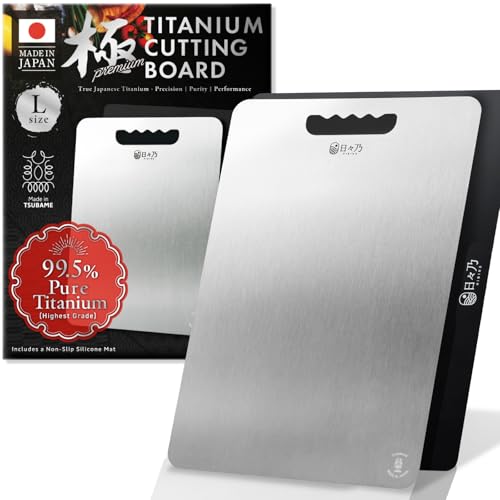
If you are dealing with large-scale meal prep or frequently find yourself breaking down whole fish or large roasts, the L Size HIBINO Titanium Cutting Board is the heavy lifter of the group. Despite its XL 17 x 12 inch dimensions, it remains incredibly portable because it is so thin. The 99.5% pure Japanese titanium is forged in Tsubame City, a place world-renowned for metalwork, and that pedigree shows in the board’s flawless finish and resistance to rust.
This is the ideal choice for the serious home chef or even a professional who needs a secondary “clean” station for proteins. Since it doesn’t absorb odors, you can chop onions on it, give it a quick rinse, and move immediately to fruit without any flavor transfer. The dishwasher-safe nature of this large board is its biggest selling point, as a wooden board this size would be a nightmare to sanitize and dry.
The downside is its footprint. Even though it’s thin, 17 inches is quite wide, and it might not fit comfortably in smaller dishwashers or standard drying racks. Also, because it’s such a large sheet of 0.04-inch titanium, it can feel a bit “springy” if it isn’t sitting perfectly flat on its non-slip mat during heavy-duty chopping.
HIBINO Titanium Cutting Board | 99.5% Pure Japanese Titanium | Non-Toxic | Lightweight & Dishwasher Safe | S Size | Made in Japan | With Non-Slip Mat | For Kitchen & Camping Use

The S Size HIBINO Titanium Cutting Board is the “utility player” of the kitchen. At 12 x 8 inches, it’s about the size of a standard piece of paper, making it the most convenient option for those quick tasks like slicing a lemon for a drink, mincing a single clove of garlic, or prepping a small snack. It’s crafted from the same highest-grade Japanese titanium as its larger siblings, meaning it’s totally non-toxic and won’t leach chemicals into your food.
I’d recommend this for apartment dwellers with minimalist kitchens or people who love camping and backpacking. It’s so light (just 9.2 oz) that you can slide it into a backpack without noticing the weight. It’s also the perfect “bar board” for someone who hosts often and needs a dedicated, clean surface for garnishes that won’t absorb citrus acids.
The trade-off is obviously the surface area. It’s too small for serious dinner prep; if you try to chop a head of cabbage on this, you’ll have leaves flying all over your counter. It is strictly for small-scale precision work, and like all titanium boards, it will produce a metallic ringing sound that might grate on your nerves if you’re used to the quiet thud of plastic or wood.
Asahi Cookin Cut Rubber Cutting Board, NE05102, Home Use, Made in Japan L 15.7 x 9.1 x 0.5 inches (40cm x 23cm x 1.3cm)

The Asahi Cookin Cut is a bit of a legend in professional Japanese kitchens, and this L-sized rubber board brings that tech to the home. What makes it stand out is the unique synthetic rubber material that feels almost like wood but performs like a high-end polymer. It has a high density that prevents the knife from sinking too deep, yet it’s soft enough to keep your edge sharp. It’s also remarkably scratch-resistant, meaning bacteria have nowhere to hide.
This board is for the person who wants professional-grade performance but doesn’t want to deal with the fragility of wood. If you do a lot of heavy chopping or use heavy cleavers, this 0.5-inch thick rubber surface absorbs the shock beautifully. It stays put on the counter without needing a mat, which makes the whole cooking process feel more secure.
The main trade-off is the weight and the care. This isn’t a “toss it in the dishwasher” board; Asahi boards can warp under high heat, so they generally require hand-washing. It’s also surprisingly heavy for its size, which might be a deterrent if you prefer lightweight tools you can easily maneuver with one hand.
Yoshihiro Hi Soft High Performance Professional Grade Cutting Board Japanese Sashimi Chef’s Tool Made in Japan (Large)

The Yoshihiro Hi Soft is widely considered the gold standard for anyone using Sashimi knives or high-carbon steel blades. The standout feature here is the high-performance synthetic material, which is specifically engineered to be “soft.” When you are doing delicate slicing, the blade feels like it’s being cradled by the board. This minimizes the impact on the microscopic edge of your knife, ensuring that your professional-grade tools stay sharp for as long as possible.
I would suggest this for the serious hobbyist who is practicing their sushi skills or anyone who owns expensive high-carbon steel knives. The Large 19.6-inch surface gives you plenty of room for long, single-stroke pulls. It’s a specialized tool for people who view cooking as a craft rather than a chore.
The downside is the aesthetics and the staining. Because it is a soft, light-colored synthetic, it can absorb colors from things like carrots or beets if you aren’t careful. It’s also quite utilitarian-looking—it looks like something you’d see in a commercial kitchen rather than a decorative piece for a home island. It’s a performance tool, not a display piece.
Asahi Cookin Cut Rubber Cutting Board, NE05103, Home Use, Made in Japan LL 16.5 x 9.8 x 0.5 inches (42cm x 25cm x 1.3cm)

The Asahi Cookin Cut LL is the larger, more robust version of the classic Japanese rubber board. Measuring 16.5 x 9.8 inches, it provides that extra bit of “breathing room” that makes a big difference when you’re dicing a mountain of onions. What makes this stand out is the synthetic rubber’s ability to dry almost instantly. It doesn’t absorb water like wood, so you don’t have to worry about mold or deep-seated bacteria, yet it offers a much better “bite” for the knife than hard plastic.
This is best for the home cook who handles a lot of raw proteins. The weight of the LL size provides excellent stability, so the board won’t slide around while you’re trimming a brisket or deboning chicken. It’s a “buy it once” kind of product that will likely outlast several cheaper plastic boards.
The trade-off is the price and the maintenance. Like the smaller version, this Asahi board is an investment, and you have to be careful not to expose it to extreme heat. It’s not dishwasher-safe in most residential units because the high-heat dry cycle can cause it to bow. You’ll be hand-washing this in the sink, and its LL size makes that a bit of a workout.
YAMASAN KYOTO UJI Japanese Hinoki Cutting Board – Small – Natural Cypress Wood Cutting Board, Kitchen Chopping Board, High Durability, Made in Japan (14.17×8.66×0.59 inch) (Small)
The Small YAMASAN KYOTO UJI Hinoki Board is a charming, compact piece of Japanese cypress. Even at its smaller size (roughly 14 x 8.6 inches), it retains that signature high durability and the wonderful, clean scent of Hinoki. What makes it stand out is how it manages to feel substantial despite its smaller footprint—it’s over half an inch thick, which gives it a premium feel that flimsy “prep boards” usually lack.
This is the perfect choice for someone living in an apartment or for use as a dedicated “fruit and cheese” board. It’s also excellent for those who find larger wooden boards too heavy to wash and dry. If you have a small Santoku or a paring knife, this board provides the perfect soft surface for precision cuts without taking over your entire counter space.
The honest trade-off is that it can feel a bit cramped for full-meal prep. If you’re trying to chop a bunch of kale or a large head of broccoli, you’ll find the edges of the board very quickly. Like all Hinoki, it also requires you to be diligent about wetting it before use to prevent food dyes from soaking into the grain and leaving permanent stains.
Kitchen Star Tsukihoshi Rubber Cutting Board Made in Japan,Dishwasher-Safe Size:13.54×8.38×0.39inches(344×213×10mm) Equipped with a Cutting Board Scraper for Synthetic Rubber Cutting Boards (M)

The Kitchen Star Tsukihoshi Rubber Cutting Board is a clever middle ground for people who want the benefits of synthetic rubber but need modern convenience. The standout feature here is that it is dishwasher-safe, which is a rarity for rubber boards. It also comes with a dedicated scraper, which is a brilliant addition—it allows you to “resurface” the board slightly if it gets stained or if you want to smooth out any deep knife marks over time.
I’d recommend this for the practical cook who wants a hygienic, made-in-Japan surface but refuses to hand-wash their kitchen gear. It’s scratch-resistant and has a “mark” to help you distinguish which side you use for meat versus vegetables, which is a great touch for food safety. It’s a very logical, well-engineered tool for a busy household.
The trade-off is that it’s a bit thinner than the professional Asahi boards at about 0.39 inches. While this makes it lighter and easier to fit in the dishwasher, it doesn’t have quite the same “thud” or premium heft as the thicker rubber boards. It feels a bit more “functional” and a bit less “luxurious” under the knife.
Product prices and availability are accurate as of the date/time indicated and are subject to change. Any price and availability information displayed on Amazon.com at the time of purchase will apply to the purchase of this product.
Buying Guide
FAQs
What are the main material differences between titanium and wooden cutting boards?
Titanium boards, like the HIBINO series, are non‑porous, odor‑resistant, and dishwasher‑safe, which makes them very low‑maintenance. Wooden boards such as Shun Hinoki or Yamasan Kyoto Uji are porous, develop a natural fragrance, and require hand‑washing and occasional oiling to keep them from drying out. Each material interacts differently with knives: titanium is ultra‑thin and gentle, while wood provides a slight “give” that can help preserve blade edges.
How do I choose the right size board for my kitchen needs?
Consider the typical prep volume: the compact HIBINO 12 × 8 in board is ideal for small tasks or limited counter space, while the XL 17 × 12 in version handles whole fish or large meat cuts. Medium‑sized wooden boards (around 15.75 × 10.75 in) strike a balance for everyday chopping and fit well in most drawers. Larger rubber boards, like the Yoshihiro Hi Soft at 19.6 × 10.6 in, give ample surface for professional‑grade prep but require more storage room.
Which board offers the best value for a home cook who wants to protect their knives?
For knife preservation, the HIBINO titanium boards are lightweight, ultra‑thin, and provide a very gentle surface, extending blade life with minimal edge wear. Hinoki wood boards also protect knives well due to their soft grain, but they need regular oiling and cannot go in the dishwasher, adding upkeep costs. Rubber boards like Kitchen Star Tsukihoshi are affordable and offer a soft impact, yet they may not be as durable long‑term as titanium.
How important is dishwasher safety when selecting a cutting board?
Dishwasher safety is a major convenience factor; the HIBINO titanium boards are fully dishwasher‑safe and resist rust and odors, making cleanup effortless. Wooden boards (Shun Hinoki, Yamasan) must be hand‑washed to avoid warping and cracking, which adds extra effort. Rubber boards such as Asahi Cookin Cut are also dishwasher‑safe, but they can retain water if not dried properly.
Do any of these boards have special features for food safety or hygiene?
Titanium boards are non‑toxic, non‑porous, and resist bacterial growth, offering a hygienic surface for raw meat. Hinoki wood naturally contains antimicrobial oils and a pleasant scent, but its pores can harbor moisture if not dried correctly. Rubber boards often claim scratch resistance and low water absorption, helping to keep food debris from accumulating.
What should I look for in terms of ergonomics and handling?
The HIBINO series includes a wave‑grip handle that provides secure control while staying lightweight, which is helpful for frequent board transfers. Wooden boards typically lack built-in handles but have smooth edges that can be lifted easily. Rubber boards are heavier, offering stability on the counter, but may be bulkier to move.
How does price compare across these material types?
Titanium boards are generally priced higher due to the premium metal and manufacturing process, but their durability can offset the initial cost over years of use. Hinoki wooden boards sit in a mid‑range price bracket, offering aesthetic appeal and good performance with moderate maintenance. Rubber boards are usually the most budget‑friendly option, though they may need replacement sooner if they become scarred.
Which cutting board is best for multi‑purpose use, like chopping vegetables, slicing meat, and rolling dough?
A medium‑sized HIBINO titanium board provides a versatile, flat surface that handles all tasks without absorbing odors, making it ideal for switching between meat and produce. Hinoki boards are also multi‑purpose, especially for vegetable prep, but they require careful cleaning between meat and veg to avoid cross‑contamination. Rubber boards offer a soft impact suitable for dough and vegetables, yet they may not be as knife‑friendly for delicate slicing.