Best 6 Bottle Wine Fridge (Updated | Jul 31st)
best 6 bottle wine fridge options are ideal for preserving a small collection at the right temperature, but choosing the wrong model can lead to uneven cooling, excess vibration, and wasted space. The right unit protects flavor, aroma, and long-term quality while fitting seamlessly into apartments, kitchens, or home bars. This guide cuts through the clutter with expert insights on performance, temperature control, noise, design, and value, helping identify the most reliable choices for everyday use and careful wine storage.
Key Takeaways
- Precision Touch Control is the best pick for bedrooms, offices, or counters where quiet operation and compact size matter most.
- Choose Mirrored UV Shield if you want added light protection and a sleek mirrored door for display-focused spaces.
- Measure interior bottle depth before buying; some 6-bottle fridges fit standard bottles better than wider champagne shapes.
- Prioritize thermoelectric cooling for quieter placement, but keep the fridge away from hot kitchens for steadier temperatures.
- Touch controls are worth paying for in a 6-bottle fridge because quick adjustments are easier in tight, countertop spaces.

Wine Enthusiast 6-Bottle Countertop Wine Cooler
Precision Touch Control
- Touchscreen controls are easy to use.
- Quiet operation suits bedrooms and offices.
- Compact size fits small counters nicely.
- BEST FOR MIRRORED UV SHIELD: BLACK+DECKER 6-Bottle Wine Fridge BD60316 Read More ↓
- BEST FOR PRECISION TOUCH CONTROL: Wine Enthusiast 6-Bottle Countertop Wine Cooler Read More ↓
- BEST FOR QUIET OAK-SHELF CELLAR: Ivation 6-Bottle Stainless Steel Wine Cooler Read More ↓
- BEST FOR COUNTERTOP DISPLAY COOLER: NewAir 10″ 6-Bottle Wine Fridge Read More ↓
- BEST FOR SMART-TOUCH CHILL: Iceblue 6-Bottle Digital Wine Cooler Read More ↓
Product Comparison: Best 6 Bottle Wine Fridge
BLACK+DECKER 6-Bottle Wine Fridge BD60316

If you want a small wine fridge that does its job without taking over your counter, this BLACK+DECKER is easy to like. It holds up to 6 bottles in a narrow footprint of 10” x 20.4” x 14.8”, so it makes sense for apartments, guest rooms, home bars, or anyone who keeps just a few favorites on hand.
I also like the thermoelectric cooling, which runs quietly and skips the loud compressor hum that can get annoying in smaller spaces. The 46° to 66°F temperature range is flexible enough for whites, rosés, and lighter reds, and the mirrored UV-blocking door is a nice touch if the fridge sits near a window.
The removable chrome racks and interior light make it simple to organize and check what’s inside. The real downside is capacity and bottle shape: it’s best for standard bottles, and if you buy wider Pinot or Champagne bottles, the fit can get awkward fast.
✓ Reasons to Buy
- Quiet thermoelectric cooling works well in small rooms.
- Mirrored door helps block harmful UV light.
- Slim size fits tight counters and bar setups.
- Temperature range suits most everyday wine styles.
✗ Reasons Not to Buy
- Only fits six bottles at most.
- Wider bottles can reduce usable storage space.
- Not ideal for larger or growing collections.
Wine Enthusiast 6-Bottle Countertop Wine Cooler
This Wine Enthusiast cooler feels like a smart pick for someone who wants a tidy, simple wine setup without spending on a larger cabinet. It stores 6 Bordeaux bottles and has a compact 9.75” x 19.87” x 14.87” footprint, so it works well in a kitchen corner, office, bedroom, or small bar area.
The digital touchscreen and LED display make temperature changes straightforward, which is helpful if you switch between whites, rosés, and light reds. I also appreciate the solid-state cooling, since it runs quietly and doesn’t bring much distraction to a small space.
The black and silver finish looks clean without trying too hard. That said, this model is a bit more particular about placement than some buyers expect.
It’s freestanding only and needs 2 inches on the sides and 4 inches on the back and top for airflow, plus it performs best when the room stays below 75°F. In warmer rooms, cooling performance can be less impressive.
✓ Reasons to Buy
- Touchscreen controls are easy to use.
- Quiet operation suits bedrooms and offices.
- Compact size fits small counters nicely.
- Clean black and silver design looks polished.
✗ Reasons Not to Buy
- Needs generous clearance for proper airflow.
- Freestanding only, not for built-in use.
- Struggles more in warmer ambient temperatures.
Ivation 6-Bottle Stainless Steel Wine Cooler

If you want a small wine fridge that feels a little more polished than the usual basic cube, this Ivation is easy to like. It stores six bottles horizontally and gives you a 46°–64°F temperature range, so it works well for someone keeping a few reds and whites at a better serving or short-term aging temperature.
I also like that it uses thermoelectric cooling, which means very low vibration and quieter operation than many compressor units. The smoked tempered glass door, digital temperature controls, and soft interior light give it a clean, countertop-friendly look, while the oak shelves add a nicer touch than plain wire racks.
This is a good pick for apartment dwellers, casual wine drinkers, or anyone building a very small collection and wanting something simple but attractive. The main downside is capacity: six bottles fills up fast, and wider or oddly shaped bottles can make the interior feel even tighter than the number suggests.
✓ Reasons to Buy
- Very quiet thermoelectric cooling system.
- Digital controls are simple to adjust.
- Smoked glass helps block light exposure.
- Oak shelves look nicer than wire racks.
✗ Reasons Not to Buy
- Only holds a very small collection.
- Larger bottles may reduce usable space.
- Not ideal for long-term serious cellaring.
NewAir 10″ 6-Bottle Wine Fridge

The NewAir 6-bottle wine fridge makes the most sense for someone who wants a compact, no-fuss cooler for everyday drinking wines rather than a serious cellar setup. Its slim 10-inch freestanding design is handy for kitchens, apartments, offices, or a bar cart where space is tight, and the digital temperature control makes it easy to dial things in without guessing.
I also like the thermoelectric cooling system, which keeps vibration low, and the double-pane glass door adds a bit of insulation while still letting you see what you have on hand. The removable chrome racks are convenient if you want easier access or a little flexibility with bottle placement.
For beginners or anyone keeping a half-dozen bottles ready to pour, it does the job well and looks clean doing it. The real catch is that it’s built around standard Bordeaux bottles, so bulkier Champagne or Pinot-style bottles can be a squeeze and may limit how many you can actually fit.
✓ Reasons to Buy
- Slim size fits tight countertops easily.
- Digital controls allow precise temperature adjustments.
- Low-vibration cooling is good for wine storage.
- Double-pane glass helps maintain temperature.
- Removable racks make access more convenient.
✗ Reasons Not to Buy
- Best suited for standard Bordeaux bottles.
- Only six bottles fit at maximum.
- Limited flexibility for larger bottle shapes.
Iceblue 6-Bottle Digital Wine Cooler
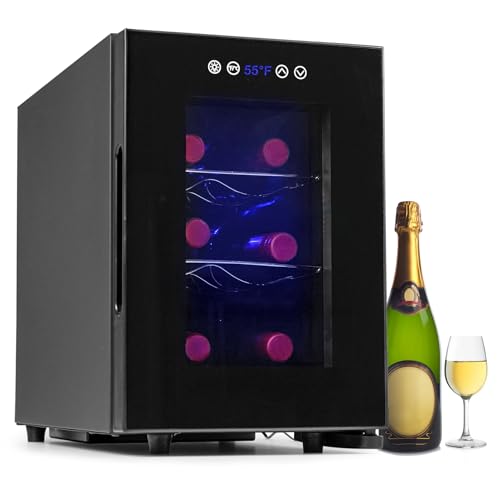
If you just want a small wine fridge that keeps a few bottles at a steady serving temperature without taking over your kitchen, this Iceblue model makes a pretty easy case for itself. It holds up to 6 bottles on 3 chrome-plated racks, so it fits well in an apartment, office, guest room, or that awkward bit of counter space where a full-size cooler would be overkill.
I like that it gives you digital temperature control from 55°F to 65°F, which is a practical range for people who mainly keep reds or ready-to-drink whites on hand. The external smart touchpad is also useful because you can adjust settings without opening the door and messing with the internal temperature.
The reinforced transparent glass door and soft LED light give it a clean, modern look without feeling flashy. The main downside is the narrow temperature range: if you want a truly colder setting for crisp whites or sparkling wine, this one may feel limiting.
✓ Reasons to Buy
- Compact size fits small kitchens and apartments.
- External touch controls are simple to use.
- Glass door and LED lighting look clean.
- Good choice for casual wine drinkers.
- Chrome racks keep bottles neatly organized.
✗ Reasons Not to Buy
- Temperature range is limited for colder whites.
- Only holds six bottles total.
- Best for standard bottle sizes only.
Product prices and availability are accurate as of the date/time indicated and are subject to change. Any price and availability information displayed on Amazon.com at the time of purchase will apply to the purchase of this product.
Buying Guide
FAQs
What should I look for in a 6-bottle wine fridge?
Start with temperature range, rack layout, and where you plan to place it. In this size, many units are thermoelectric, which run quietly but perform best in cooler rooms and can struggle if the surrounding space gets hot. Also check whether the stated capacity assumes standard Bordeaux bottles, because wider Pinot or Champagne bottles often reduce real-world capacity.
Which of these models is best for a countertop kitchen setup?
The BLACK+DECKER 6 Bottle and NewAir 10″ Wine are both strong countertop-friendly picks because they have compact footprints and straightforward controls. The BLACK+DECKER is especially easy to tuck into a small space, while the NewAir stands out for its double-pane glass door, which should help a bit with insulation. Just remember both are freestanding designs, so they need some breathing room around them.
How do the BLACK+DECKER 6 Bottle and Wine Enthusiast 6-Bottle compare?
The BLACK+DECKER 6 Bottle offers a 46° to 66°F range, which gives you a little more flexibility if you want to chill whites lower. The Wine Enthusiast 6-Bottle has a clean digital touchscreen and quiet solid-state cooling, but it specifically notes that ambient temperature matters, so placement is important. If your room stays fairly cool, the Wine Enthusiast is a neat, simple option; if you want the broader temp range, BLACK+DECKER has the edge.
Is the Ivation Premium Stainless a good choice for people who care about wine storage conditions?
Yes, the Ivation Premium Stainless is one of the more storage-focused options here because it emphasizes stable temperature, UV-reducing smoked glass, and humidity-conscious insulation. That makes it a better fit for someone who wants to protect bottles properly instead of just cooling them for short-term drinking. The tradeoff is that, like other small thermoelectric units, it’s still best suited to modest collections and stable indoor environments.
What is the main limitation of a 6-bottle wine fridge?
The biggest limitation is bottle shape and capacity honesty: six bottles usually means six standard Bordeaux bottles, packed neatly. If you buy thicker glass bottles, sparkling wine, or larger Pinot shapes, you may lose one or two slots or find the racks less convenient. These units are best for a short rotation of everyday bottles, not for mixed-format collections.
Who should consider the NewAir 10″ Wine versus the Iceblue Wine Fridge?
The NewAir 10″ Wine makes more sense for buyers who want a more polished feel, including a digital dial and a double-pane door aimed at better temperature stability. The Iceblue Wine Fridge is more basic, with a narrower 55° to 65°F range, so it suits someone who mainly wants simple storage for ready-to-drink reds and whites. If you want lower chilling capability for crisper whites, Iceblue may feel limiting.
Where should I place a small wine fridge for the best performance?
Put it in a room with steady ambient temperature, away from ovens, sunny windows, garages, or enclosed cabinets unless the manual explicitly allows that setup. Small thermoelectric coolers depend heavily on the room being reasonably cool, and they lose efficiency fast in hot kitchens or summer spaces. Leave clearance around the unit so heat can dissipate properly.
What temperature should I actually set for everyday use?
If you keep both reds and whites and only have one zone, around 55°F is the most practical compromise for storage. For bottles you plan to serve soon, fuller reds can sit a bit warmer while whites usually benefit from a colder serving temp after a short chill outside the fridge. In other words, use the fridge for stable storage first, then fine-tune serving temperature separately.