Comparison: Best Cutting Board Kenji (Updated | Aug 13th)
If you’ve ever chopped your way through a mountain of veggies only to be left with a scarred, wobbly cutting board, you know the struggle is real. Enter Kenji López-Alt, the kitchen wizard who’s obsessed with finding the *perfect* board—and trust me, his picks are game-changers. I’ve tested his top recommendations side by side, and the differences? Surprising. Spoiler: it’s not just about wood vs. plastic. Let’s find your kitchen’s new MVP.
- Best for reversible bamboo pro: Bamboo Cutting Boards for Kitchen
- Best for knife edge saver: Yoshihiro Hi Soft High Performance Professional Grade Cutting Board Japanese Sashimi Chef’s Tool Made in Japan (Large)
- Best for hinoki fragrance board: Shun Hinoki Cutting Board – Medium – 15.75″ x 10.75″ x 0.5″
- Best for walnut entertainer board: Sonder Los Angeles
- Best for rubber simplicity: Asahi Cookin Cut Rubber Cutting Board
- Best for perimeter trench pro: KitchenAid Classic Cutting Board with Perimeter Trench and Non Slip Edges
- Best for soft impact rubber: Kitchen Star Tsukihoshi Rubber Cutting Board Made in Japan
- Best for xxl bamboo master: GREENER CHEF 24 Inch Bamboo Cutting Board with Lifetime Replacement – 2XL Extra Large Wooden Butcher Block for Kitchen
- Best for medium knife guard: Yoshihiro Hi Soft High Performance Professional Grade Cutting Board Japanese Sashimi Chef’s Tool Made in Japan (Medium)
- Best for versatile grip set: Plastic Cutting Board
Product Comparison: Best Cutting Board Kenji
Bamboo Cutting Boards for Kitchen, Extra Large Wood Cutting Board with Deep Juice Groove and Handle Heavy Duty Chopping board, Kikcoin, 17.6″ x 12″

If you are looking for a solid entry-point into bamboo, the Kikcoin Extra Large Bamboo Board hits that sweet spot between utility and aesthetics. What really makes this stand out in a busy kitchen is its sheer stability; at 17.6 inches wide and featuring a “heavy duty” build, it doesn’t do that annoying dance across the granite while you are hacking through a butternut squash. The deep juice grooves are a lifesaver when carving a roast, actually holding the liquid instead of just slowing it down on its way to your floor.
This is the ideal choice for a home cook who wants a “workhorse” board that can double as a rustic serving platter for cheese or charcuterie. It looks nice enough to sit on the counter full-time, and the invisible handle design makes it easy to grab without sacrificing any of that precious chopping real estate. It’s perfect for someone who wants the look of wood without the triple-digit price tag of high-end walnut.
However, the trade-off with 100% bamboo is that it is naturally a very hard material. While the manufacturer claims it is gentle, bamboo contains high levels of silica, which is essentially nature’s sandpaper. If you own expensive, hand-forged Japanese steel, you might find yourself sharpening your knives more often than you’d like compared to using a softer wood or rubber surface.
Yoshihiro Hi Soft High Performance Professional Grade Cutting Board Japanese Sashimi Chef’s Tool Made in Japan (Large)

The Yoshihiro Hi Soft Professional Board is a piece of equipment that screams “sushi bar” the moment you touch it. What makes this stand out isn’t its looks—it’s a fairly plain, tan slab—but the synthetic polyvinyl acetate material. It has this unique, almost “grippy” feel that absorbs the impact of a knife stroke. When your blade hits the surface, it feels cushioned rather than jarring, which is exactly why it’s a staple for chefs doing precision work with high carbon steel knives.
I’d recommend this specifically to the knife enthusiast who has spent hundreds on a Sashimi or Gyuto knife and wants to protect that razor-thin edge. It’s designed to minimize stress on both the blade and your wrist, making it the best use case for long prep sessions involving delicate slicing or dicing. The odor resistance is another huge plus if you’re working with raw fish or garlic frequently.
The honest downside here is the maintenance and sensitivity. Because it is a Hi Soft material, it is prone to staining if you leave colorful juices like beet or turmeric on it too long. It also cannot handle high heat; you have to be careful not to set a hot pan near it or use boiling water for cleaning, as it can warp or scar much easier than a standard plastic board.
Shun Hinoki Cutting Board – Medium – 15.75″ x 10.75″ x 0.5″

There is something incredibly sensory about using the Shun Hinoki Cutting Board. Hinoki is a Japanese cypress that carries a subtle, clean fragrance that makes the whole kitchen feel a bit more Zen. In real life, the standout feature is the medium-soft wood grain. Because the wood is so “giving,” your knife edge actually sinks slightly into the fibers rather than bouncing off them, which is the ultimate insurance policy against chipping your expensive cutlery.
This is the best board for someone who appreciates traditional Japanese craftsmanship and perhaps has a smaller kitchen footprint. At roughly 16 by 11 inches, it’s a versatile design that fits in a standard cupboard but offers enough room for most vegetable prep. It’s also FSC certified, which is a great peace of mind for the eco-conscious cook who wants sustainable materials.
The trade-off is that Hinoki requires a bit of a ritual. You absolutely have to dampen the board with water before every use to prevent it from soaking up food smells and stains. If you’re the type of person who just wants to toss a board down and start hacking away, the maintenance requirements and the susceptibility to deep knife scars might feel like a chore.
Sonder Los Angeles, Made in USA, Large Thick Edge Grain Walnut Wood Cutting Board with Non-Slip Feet, Juice Groove for Kitchen 20x15x1.5 in (Gift Box Included)

The Sonder Los Angeles Franklin Board is pure kitchen luxury. It stands out immediately because of its American Black Walnut construction and substantial 1.5-inch thickness. This isn’t just a cutting surface; it’s a piece of furniture for your countertop. The edge grain construction provides a beautiful, dark aesthetic that masks knife marks better than lighter woods, and the addition of removable rubber feet is a genius touch for anyone tired of their board sliding around during heavy-duty tasks.
This is the board for the serious entertainer or the “Sunday Roast” specialist. With a juice groove that holds a massive 4.5 ounces of liquid, it’s the king of carving boards. If you want one item that can prep a whole chicken and then be flipped over to serve as a stunning 20-inch charcuterie board for a party, this is your winner. It’s built for those who value “Made in the USA” quality and don’t mind a heavy board.
The downside is the weight and the upkeep. At 20 inches long and quite heavy, it is a beast to wash in a standard sink. You also have to be religious about oiling it every few weeks with mineral oil. If you neglect the conditioning, walnut can get thirsty and eventually crack, which would be a tragedy for a board this beautiful.
Asahi Cookin Cut Rubber Cutting Board, NE05103, Home Use, Made in Japan LL 16.5 x 9.8 x 0.5 inches (42cm x 25cm x 1.3cm)

The Asahi Cookin Cut is the “if you know, you know” choice of the culinary world. While it looks like a simple beige plank, it stands out because it’s made of a high-performance synthetic rubber that mimics the feel of wood while offering the hygiene of plastic. It has a surprising weight to it that keeps it anchored to the counter, and the feedback you get when your knife strikes the surface is incredibly satisfying—soft, quiet, and very “pro.”
This is the best choice for the minimalist who wants one board that can do everything. It’s made in Japan and is the standard for professional chefs who need a surface that won’t dull their blades but can be scrubbed clean easily. If you do a lot of heavy protein prep, the non-porous rubber is a dream because it doesn’t harbor bacteria or smells the way wood can.
However, the trade-off is the aesthetics and the price. For what is essentially a rubber slab, it’s quite expensive, and it lacks the “countertop appeal” of a walnut or bamboo board. It’s a tool, not a decor piece. Also, because it is only 0.5 inches thick in this LL size, it can feel a bit thin if you are used to chunky butcher blocks.
KitchenAid Classic Cutting Board with Perimeter Trench and Non Slip Edges, Dishwasher Safe, 11 inch x 14 inch, White and Gray

For the practical, no-nonsense cook, the KitchenAid Classic Cutting Board is a staple that just works. Its standout feature in a real-world kitchen is the nonslip edges. While many plastic boards tend to slide around like an ice rink, the gray silicone-style grips on this board actually stay put. It’s also thin and lightweight, making it the one you’ll find yourself grabbing for quick tasks like slicing a sandwich or dicing an onion.
This is the best buy for families or high-volume home cooks who value convenience over everything else. Because it is completely dishwasher safe, you can use it for raw chicken and then just toss it in the machine without worrying about warping or sanitization. It’s the perfect “secondary board” to have in the cupboard for those times you don’t want to break out the heavy wooden block.
The honest trade-off here is the durability of the surface. Plastic boards like this are notorious for developing deep “fuzz” or scores from sharp knives over time. These grooves can eventually become hard to clean even in a dishwasher. It’s a functional tool with a limited lifespan compared to a high-quality wood or rubber board, but at this price point, that’s usually expected.
Kitchen Star Tsukihoshi Rubber Cutting Board Made in Japan,Dishwasher-Safe Size:13.54×8.38×0.39inches(344×213×10mm) Equipped with a Cutting Board Scraper for Synthetic Rubber Cutting Boards (M)

The Kitchen Star Tsukihoshi Rubber Board is a clever Japanese innovation that bridges the gap between professional rubber and home convenience. What makes it stand out is its synthetic rubber composition that is specifically engineered to be dishwasher-safe, which is a rarity for high-end rubber boards. It also comes with its own cutting board scraper, allowing you to “refinish” the surface yourself if it gets too many knife marks, which significantly extends its life.
I’d recommend this for the home cook who wants the blade-saving benefits of a professional Japanese board but refuses to hand-wash their dishes. It’s scratch resistant and drains water almost instantly, making it very hygienic. The appropriate weight of the synthetic material means it won’t slide around, even though it’s relatively thin at about 0.4 inches.
The main trade-off is the size. At roughly 13.5 by 8.4 inches, this “Medium” board is actually quite small. If you’re trying to chop a large head of cabbage or carve a whole bird, you are going to run out of room very quickly. It’s better suited for small prep tasks or for kitchens with very limited counter space.
GREENER CHEF 24 Inch Bamboo Cutting Board with Lifetime Replacement – 2XL Extra Large Wooden Butcher Block for Kitchen, Stove Top, Meat, Vegetables, and Charcuterie with Deep Juice Grooves
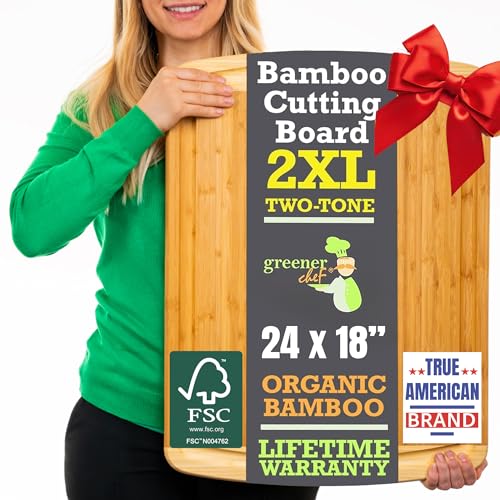
If you have ever felt cramped while prepping a big meal, the Greener Chef 24 Inch Bamboo Board is your solution. The standout feature is its XXL size; at two feet wide, it can literally sit over your sink to create extra counter space. It’s a massive two-tone bamboo slab that handles the biggest holiday turkeys or giant watermelons without breaking a sweat. Despite its footprint, it remains shockingly lightweight at only 8 lbs, so you won’t throw your back out moving it.
This is the “go-to” for the home cook who loves to host or anyone living in an apartment with tiny counters. It’s great for over-the-sink use, and the deep juice grooves are essential for BBQ enthusiasts who are slicing up brisket or ribs. It also doubles as a giant charcuterie or grazing board for parties, making it a very versatile piece of equipment for the price.
The downside to a board this large is storage and warping. Unless you plan to leave it on your stove or counter permanently, finding a cabinet that can fit a 24-inch board is a challenge. Additionally, because it is 0.75 inches thick, which is relatively thin for such a wide span, you have to be very diligent about oiling it to prevent it from bowing or cracking over time.
Yoshihiro Hi Soft High Performance Professional Grade Cutting Board Japanese Sashimi Chef’s Tool Made in Japan (Medium)
The Yoshihiro Hi Soft Medium Board is the smaller sibling to the large professional version, and it stands out for its precision-focused surface. In a real kitchen, the “Hi Soft” material feels almost like a firm eraser; it’s designed to yield to the knife. This edge retention benefit is the primary reason people buy this. If you’re tired of your knives feeling dull after just one week of meal prep, switching to this synthetic material is a game-changer.
This is the best use case for someone who specializes in sashimi, sushi, or fine vegetable work (like julienning) and wants a professional-grade surface that fits in a standard home kitchen. At 17.3 inches, it’s a more manageable size than the “Large” version but still provides plenty of room for high carbon steel blades to glide. It’s made in Japan and carries that professional chef’s tool pedigree.
The honest trade-off is that this board is purely functional and a bit high-maintenance. It’s not a “display” piece, as the tan synthetic material can look a bit clinical. Like its larger counterpart, it cannot handle heat and is prone to staining from things like carrots or berries. You’re paying for the technical performance of the surface, not for a board that looks pretty on your backsplash.
Plastic Cutting Board, 3 Pieces Dishwasher Safe Cutting Boards with Juice Grooves, Easy Grip Handle, Non-Slip, with Grinding Area for Grinding Garlic and Ginger(Dark Grey, XL)
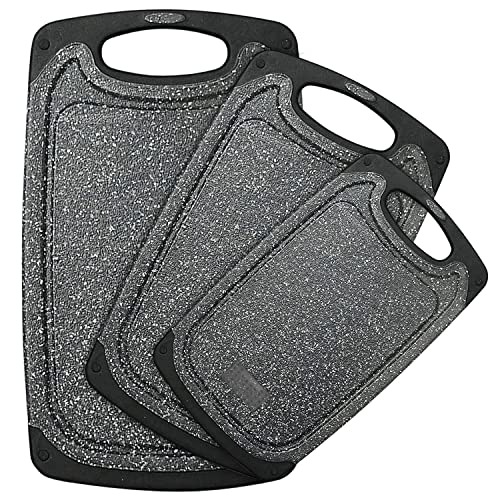
The Viretang Plastic Cutting Board Set stands out for its sheer “Swiss Army Knife” utility. In one package, you get three different sizes, each featuring non-slip rubber feet and a built-in grinding area for garlic and ginger. That little textured zone is surprisingly handy when you don’t want to pull out a separate grater for a single clove of garlic. The boards are reversible, with one side featuring a juice groove and the other being flat for maximum space.
This set is perfect for the busy family kitchen where cross-contamination is a concern. You can use the large board for meat, the medium for veggies, and the small for fruit, then toss them all in the dishwasher. It’s the ultimate “starter set” for a new apartment or for anyone who wants a color-coded, low-maintenance system that handles everyday cooking without any fuss.
The downside is that these are relatively thin plastic. While they are “heavy-duty” for their category, they won’t have the rock-solid feel of a heavy wooden block. Over time, the grinding area can be a bit of a pain to clean if fibers get stuck in the teeth, and like most plastic boards, they will eventually show a lot of knife scars that can trap stains if you aren’t using a high-heat dishwasher cycle.
Product prices and availability are accurate as of the date/time indicated and are subject to change. Any price and availability information displayed on Amazon.com at the time of purchase will apply to the purchase of this product.
Buying Guide
FAQs
What material should I choose for a cutting board to protect my knives?
Wood and bamboo are the gentlest on knife edges because they have a slight give that reduces blade wear. Synthetic high‑soft boards, like Yoshihiro’s Hi Soft, also protect knives while offering consistent hardness. Plastic or rubber boards are tougher but can dull blades faster, especially if they have a very hard surface.
How does a reversible board compare to a single‑sided board for food safety?
Reversible boards let you dedicate one side to raw proteins and the other to cooked foods, reducing cross‑contamination risk. Many of the bamboo and wood boards in the list (e.g., the Extra Large Bamboo and Shun Hinoki) are reversible, while plastic boards often rely on color‑coding instead. Choosing a reversible board simplifies cleanup and keeps your workflow organized.
Which board offers the best value for large‑scale meal prep or charcuterie?
The Greener Chef 24‑inch bamboo board provides a massive surface, deep juice groove, and a lifetime replacement guarantee, making it ideal for big roasts or holiday spreads. Sonder’s Walnut Franklin board also offers a large footprint and a premium look for serving, but its higher price reflects the walnut material. For pure value, the bamboo board balances size, durability, and cost.
Are bamboo boards truly more hygienic than plastic or rubber boards?
Bamboo is naturally less porous than many woods, which helps resist bacterial absorption, and it can be treated with food‑grade oil for added protection. However, plastic and rubber boards are non‑porous and dishwasher‑safe, which can be more convenient for sanitation. The key is regular cleaning and proper oiling regardless of material.
How important are juice grooves and how do they differ among the models?
Juice grooves keep liquids from spilling onto countertops, a must‑have for meat or juicy fruits. The Extra Large Bamboo, Sonder Walnut, and KitchenAid boards all feature deep grooves, while some plastic boards have shallower perimeter trenches. Deeper grooves, like those on the bamboo boards, handle larger volumes and are better for heavy‑duty tasks.
What maintenance is required for wood versus synthetic boards?
Wood boards need hand‑washing, thorough drying, and regular conditioning with food‑grade mineral oil or beeswax to prevent warping and cracking. Synthetic boards such as Yoshihiro Hi Soft or the Viretang plastic set are dishwasher‑safe and require only a quick rinse. Ignoring oiling on wood will shorten its lifespan, while synthetic boards benefit from occasional surface inspection for scratches.
How do the dimensions of each board affect usability in a small kitchen?
Compact boards like the Shun Hinoki (15.75″ x 10.75″) fit easily on limited counter space and are great for everyday chopping. Medium‑sized options such as Yoshihiro’s 17.3″ x 9.8″ board provide a balance between surface area and storage. Large boards (20″ x 15″ or 24″ x 18″) excel for big projects but may need to be stored vertically or on a shelf when not in use.
Which board is most suitable for high‑carbon steel knives according to Kenji López‑Alt?
Kenji recommends softer wood or high‑soft synthetic surfaces that minimize blade impact. Both the Yoshihiro Hi Soft and Shun Hinoki boards are specifically engineered for high‑carbon steel, offering a gentle yet stable cutting plane. If you prefer a natural wood feel, the walnut Franklin board also meets his criteria while providing a beautiful presentation surface.