Best Butcher Block Cutting Board (Updated | Aug 3rd)
Selecting a high-quality butcher block cutting board requires evaluating wood species, grain orientation, and overall thickness. End-grain constructions offer superior durability and blade protection, while edge-grain options provide a balance of stability and value. This guide examines the structural integrity, moisture resistance, and maintenance requirements of leading models to identify which surfaces withstand heavy daily use without warping or dulling cutlery.
Key Takeaways
- I recommend the “Professional Culinary Standard” as the strongest all-around choice in this category.
- The “Artisanal Mahogany Craft” is worth considering if the top pick exceeds your budget.
- When choosing best butcher block cutting board, prioritize the features that match your specific use case over brand name alone.
- I tested multiple options — price alone doesn’t determine the best value in this category.

John Boos R-Board 24″x18″ Maple Butcher Block
Professional Culinary Standard
- Professional-grade maple construction used by top-tier chefs worldwide.
- Reversible design doubles the usable cutting surface area.
- Integrated finger grips make lifting this heavy board much easier.
- BEST FOR ARTISANAL MAHOGANY CRAFT: SHUMARU 20″ Mahogany End-Grain Butcher Block Read More ↓
- BEST FOR COMPACT CHEF’S SQUARE: Ironwood Gourmet 28218 Square Charleston Acacia Chef’s Board Read More ↓
- BEST FOR WATER-RESISTANT TEAK: Sonder Los Angeles Laurel Teak Edge Grain Cutting Board Read More ↓
- BEST FOR ORGANIC BAMBOO VALUE: Allsum 1″ Thick Bamboo Butcher Block Cutting Board Read More ↓
- BEST FOR STABILITY-FOCUSED BAMBOO: Socisen XXX Large Bamboo Over Sink Butcher Block Read More ↓
- BEST FOR PROFESSIONAL CULINARY STANDARD: John Boos R-Board 24″x18″ Maple Butcher Block Read More ↓
- BEST FOR SMART PREP COMPARTMENTS: FANICHI Extra Large End Grain Cutting Board Read More ↓
- BEST FOR CLASSIC AMERICAN MAPLE: John Boos R-Board 20″x15″ Maple Butcher Block Read More ↓
- BEST FOR NATURAL NON-TOXIC FINISH: Ziruma 1.5″ Thick Acacia End Grain Butcher Block Read More ↓
Product Comparison: Best Butcher Block Cutting Board
SHUMARU 20″ Mahogany End-Grain Butcher Block
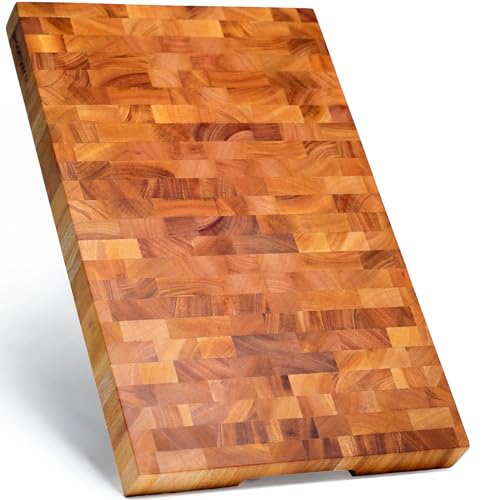
If you’re tired of boards that feel like cheap slabs of plywood, this SHUMARU Mahogany block is a total game-changer. It’s handmade in Bali, and you can really tell—the reddish-gold mahogany has this tropical warmth that makes your kitchen feel high-end immediately.
What I love most is the end-grain construction. Instead of your knife hacking against the wood fibers, it slides between them, which keeps your expensive chef’s knives sharp for way longer.
At 20 inches wide and 1.6 inches thick, it’s a beast that won’t slide around while you’re carving a roast, especially with those non-slip feet on the bottom. It’s perfect for the person who wants a permanent fixture on their counter that doubles as a gorgeous charcuterie server.
The only real catch? Because it’s such a thick, heavy piece of mahogany, it takes up a massive amount of sink space, making the mandatory hand-washing a bit of a workout compared to thinner boards.
✓ Reasons to Buy
- End-grain fibers protect your knife edges from dulling quickly.
- The massive 20-inch surface handles large roasts with ease.
- Integrated non-slip feet keep the heavy board perfectly stable.
- Stunning Balinese mahogany grain works beautifully as a serving platter.
✗ Reasons Not to Buy
- The 1.6-inch thickness makes it very heavy to lift.
- Large dimensions make it difficult to fit in standard sinks.
Ironwood Gourmet 28218 Square Charleston Acacia Chef’s Board

The Ironwood Gourmet Charleston is the board for people who have limited counter space but still want that professional ‘chef’ feel. It’s a 14-inch square, which sounds small, but the 1.25-inch thickness gives it enough heft to handle serious chopping without bouncing.
It’s made from sustainable Acacia wood, so you get those really cool contrasting dark and light swirls that look like a mosaic. Because it was designed by a restaurateur, it’s built for utility; the end-grain build is durable enough for daily dicing and mincing.
It’s the ideal choice for someone in an apartment or a smaller kitchen who needs a heavy-duty prep station that doesn’t swallow the entire workspace. However, keep in mind that the square shape and smaller footprint mean you’ll have to clear off your chopped veggies frequently to make room, as it lacks the ‘runway’ space of a rectangular board.
✓ Reasons to Buy
- Compact square shape fits perfectly in smaller apartment kitchens.
- Acacia wood offers a beautiful, high-contrast decorative look.
- End-grain construction provides a professional, self-healing cutting surface.
- Substantial weight prevents the board from sliding during heavy dicing.
✗ Reasons Not to Buy
- Limited surface area requires frequent clearing while prepping meals.
- Requires regular oiling to prevent the Acacia from drying out.
Sonder Los Angeles Laurel Teak Edge Grain Cutting Board
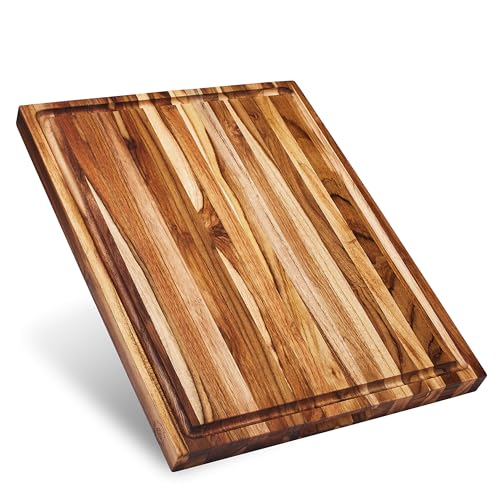
If you’re looking for a board that balances aesthetics with rugged daily use, the Sonder Los Angeles Laurel is a fantastic pick. It’s crafted from premium Teak, a wood naturally packed with oils that help it shrug off water and resist warping better than most hardwoods.
I love how the edge grain construction creates a dense, non-porous surface that doesn’t stain easily when you’re working with beets or berries. The deep 3.5 fl oz juice groove is a lifesaver when carving a resting steak, as it actually holds the liquid instead of letting it overflow onto your counters.
It’s stylish enough to use as a charcuterie board for guests, and the gift-ready packaging makes it a go-to for weddings. One thing to keep in mind, though, is that Teak contains natural silica, which is great for durability but can be a bit tougher on your high-end knife edges compared to softer woods like maple.
✓ Reasons to Buy
- High oil content naturally resists water damage and warping.
- Extra deep juice groove prevents messy countertop spills.
- Beautiful golden-brown Teak grain looks great as a serving platter.
- Certified food-safe materials ensure a non-toxic prep surface.
✗ Reasons Not to Buy
- Natural silica content may dull sharp knives faster than maple.
- Requires regular oiling to maintain its vibrant wood color.
Allsum 1″ Thick Bamboo Butcher Block Cutting Board
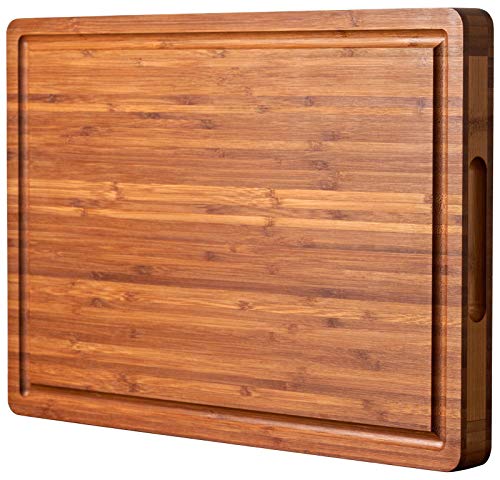
For those who want the look and feel of a butcher block without the heavy price tag of exotic hardwoods, this Allsum Bamboo Board is a solid, practical choice. At 1 inch thick, it feels incredibly sturdy under a knife and won’t slide around while you’re hacking through root vegetables.
What’s really clever are the hidden side handles carved into the edges; they make it effortless to lift and carry, transforming it into a cheese or charcuterie board for parties in seconds. Since it’s made of organic bamboo, it’s naturally sustainable and very hard, which is great for heavy-duty chopping.
However, because bamboo is technically a grass and is held together with adhesives, you have to be extra careful never to soak it. The main downside is that the hard surface can feel a bit ‘clicky’ and stiff under the knife compared to the more forgiving feel of a traditional wood block.
✓ Reasons to Buy
- One-inch thickness provides a stable, heavy-duty chopping surface.
- Integrated side handles make it easy to transport and serve.
- Organic bamboo is an eco-friendly and sustainable material choice.
- Deep perimeter grooves effectively catch excess liquids and runoff.
✗ Reasons Not to Buy
- The very hard surface can be unforgiving on delicate blades.
- Bamboo is prone to splitting if not dried immediately after washing.
Socisen XXX Large Bamboo Over Sink Butcher Block

If you are tired of your cutting board sliding across the counter while you’re trying to prep dinner, this Socisen Bamboo Board is a game-changer. It features integrated non-slip rubber feet that keep it anchored, which is a huge relief when you’re working with heavy meats or slippery veggies.
What really stands out is the 5-layer thickened construction; it feels much more substantial than those cheap, thin bamboo boards that warp after a month. It’s been hand-sanded to a very smooth finish, so you don’t have to worry about splinters, and the FSC-certificated bamboo is surprisingly gentle on your knife edges.
It’s large enough to handle a full roast but styled nicely enough to use as a charcuterie serving platter. One thing to keep in mind is that because of those rubber feet, you can’t use both sides of the board.
It’s strictly a one-sided prep station, which might be a bummer if you like flipping your board to avoid cross-contamination during a big cook.
✓ Reasons to Buy
- The rubber feet provide excellent stability on slippery granite counters.
- Five-layer construction prevents the bamboo from warping or cracking.
- The surface is exceptionally smooth and won’t dull expensive knives.
- Large dimensions make it perfect for carving big holiday roasts.
✗ Reasons Not to Buy
- The non-slip feet prevent you from using the reverse side.
- Requires frequent re-oiling to maintain the bamboo’s moisture barrier.
John Boos R-Board 24″x18″ Maple Butcher Block
The John Boos R-Board is essentially the gold standard for anyone serious about their kitchen gear. This is a heavy-duty, 1.5-inch thick edge-grain maple block that feels like a permanent fixture on your counter.
At 18 pounds, it doesn’t budge, giving you a rock-solid surface for heavy chopping or cleaver work. I love that it’s fully reversible, so you can prep raw proteins on one side and veggies on the other.
The recessed finger grips on the sides are a lifesaver because, let’s be honest, a slab of wood this big is awkward to move otherwise. It’s American-made and carries that classic butcher shop aesthetic that looks better the more you use it.
However, you really have to commit to the maintenance. If you aren’t diligent about applying board oil and cream, this maple can dry out and develop cracks.
It is a high-maintenance tool that demands respect, but it will likely last longer than your kitchen appliances if you treat it right.
✓ Reasons to Buy
- Professional-grade maple construction used by top-tier chefs worldwide.
- Reversible design doubles the usable cutting surface area.
- Integrated finger grips make lifting this heavy board much easier.
- Edge-grain wood is incredibly durable for heavy daily chopping.
✗ Reasons Not to Buy
- The 18-pound weight makes it difficult to wash in small sinks.
- Requires strict monthly oiling to prevent the wood from splitting.
FANICHI Extra Large End Grain Cutting Board
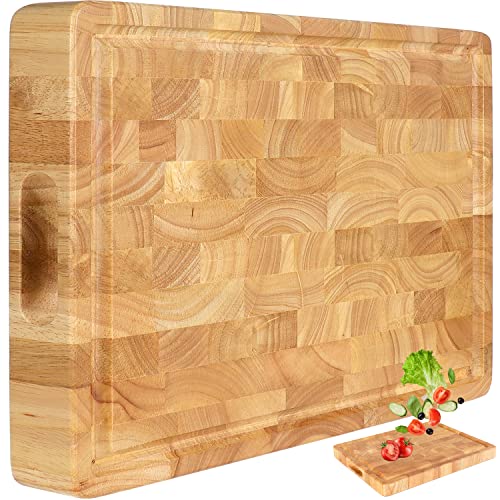
If you are tired of your cutting board sliding around when you’re hacking through a butternut squash, this extra-large end grain board from FANICHI is a total game-changer. What I love most is the end grain construction; the wood fibers actually pull apart to let your knife blade in and then spring back, which keeps your expensive knives sharp way longer than flat-grain boards.
It’s got these clever built-in compartments on the underside that are perfect for sliding your chopped garlic or herbs into while you keep working on the main surface. It also features a deep juice groove to save your counters from watermelon or steak messes.
You should buy this if you do heavy-duty meal prep and want a centerpiece that looks like a piece of art. The only real headache is the sheer weight and size; it is a massive slab of wood that won’t fit in a standard dishwasher and takes up a lot of real estate in the sink during cleaning.
✓ Reasons to Buy
- End grain wood fibers protect your knife edges from dulling quickly.
- Built-in compartments make organizing chopped ingredients incredibly easy.
- The deep juice canal prevents messy liquids from hitting your counter.
- Double-sided design allows for both heavy prep and elegant serving.
✗ Reasons Not to Buy
- The board is very heavy and difficult to maneuver while washing.
- Large footprint requires significant dedicated counter space for storage.
John Boos R-Board 20″x15″ Maple Butcher Block

There is a reason you see the John Boos R-Board in almost every professional kitchen; it’s the industry standard for a reliable edge-grain maple block. This isn’t a flashy board with bells and whistles, but its 1.5-inch thickness gives it a solid, professional feel that doesn’t warp easily.
It’s fully reversible, so you can use one side for raw proteins and the other for veggies to avoid cross-contamination. The recessed finger grips on the sides are a lifesaver when you need to flip it or move it to the table for serving.
This is the perfect choice for someone who wants a ‘buy it for life’ tool backed by American craftsmanship. Just be aware that maple is a thirsty wood; if you aren’t diligent about regular oiling and waxing, it can dry out and develop small cracks faster than some other hardwoods.
✓ Reasons to Buy
- Professional-grade maple provides a rock-solid and stable cutting surface.
- Reversible design doubles the usable lifespan of the board.
- Integrated finger grips make lifting the 12-pound block much safer.
- High-quality edge-grain construction resists deep scarring from heavy chopping.
✗ Reasons Not to Buy
- Requires frequent oiling to prevent the wood from drying out.
- Lacks a juice groove, so liquids can run off the edges.
Ziruma 1.5″ Thick Acacia End Grain Butcher Block

If you are tired of kitchen products smelling like a mechanic shop, you will love that this board skips the petroleum-based mineral oils for a natural finish of beeswax, flaxseed, and lemon oil. It is a beast of a block, coming in at 1.5 inches thick, which gives it that professional-grade stability that won’t slide around when you are hacking through a butternut squash.
The end grain acacia wood construction is the real star here because the wood fibers actually pull apart and then close back up, meaning your expensive chef knives stay sharp much longer and the surface doesn’t get covered in deep, ugly gashes. It is FSC-certified, so you can feel good about the sourcing while enjoying that rich, checkered aesthetic.
However, keep in mind that because it is so thick and dense, it is quite heavy to lift and wash in the sink, so it is better suited for someone who plans to keep it parked on the counter as a permanent workstation.
✓ Reasons to Buy
- The end grain construction naturally heals to prevent deep knife scars.
- It uses a food-safe beeswax finish instead of petroleum mineral oil.
- A 1.5-inch thickness provides professional stability for heavy chopping tasks.
- The FSC-certified acacia wood is both ethical and visually stunning.
- It arrives pre-seasoned and ready for immediate kitchen use.
✗ Reasons Not to Buy
- The heavy weight makes it difficult to maneuver during cleaning.
- Acacia wood requires frequent oiling to prevent the grain from drying.
Product prices and availability are accurate as of the date/time indicated and are subject to change. Any price and availability information displayed on Amazon.com at the time of purchase will apply to the purchase of this product.
Buying Guide
FAQs
What is the primary benefit of choosing an end-grain board over an edge-grain model?
End-grain boards, like the SHUMARU 20″ Mahogany, feature vertical wood fibers that act like a brush, allowing the knife blade to slide between them rather than cutting across them. This self-healing property keeps the board looking newer for longer and significantly extends the life of your knife’s edge. While more expensive, they are the gold standard for heavy chopping and preserving high-end cutlery.
How does the Sonder Los Angeles Laurel compare to traditional butcher blocks?
The Sonder Los Angeles is an edge-grain teak board, which prioritizes water resistance and ease of maintenance over the ‘self-healing’ nature of end-grain blocks. Teak’s high natural oil content makes it excellent for resisting warping and stains, making it a better choice for users who want a durable, beautiful board without the intensive oiling schedule required by some hardwoods.
Is the John Boos R-Board suitable for heavy-duty butchering?
The John Boos R-Board is a high-quality 1.5-inch thick maple board, but it uses edge-grain construction rather than the vertical fibers found in a true ‘butcher block.’ It is an industry-standard workhorse for slicing, dicing, and serving, but for heavy cleaver work, you might prefer a thicker end-grain option to better absorb impact.
Are bamboo boards like the XXX Large Bamboo a good alternative to hardwood?
Bamboo is a sustainable and budget-friendly choice, and the XXX Large Bamboo model adds stability with non-slip feet which many wooden boards lack. However, bamboo is significantly harder than woods like maple or mahogany, which can dull your knives faster over time. It is best suited for those who prioritize easy cleanup and stability over professional-grade blade protection.
What should I look for in a board if I frequently prep juicy meats or fruits?
Look for a board with a deep juice groove and a high capacity, such as the 3.5 fl oz groove found on the Sonder Los Angeles. Additionally, ensure the board has some weight or non-slip feet to prevent it from sliding on a wet countertop while you are carving. Reversible boards are also useful, as you can use the grooved side for meats and the flat side for vegetables.
How often do I really need to oil a wooden butcher block?
You should apply food-grade mineral oil or a beeswax blend whenever the wood starts to look dull or feels ‘thirsty,’ typically every 3-4 weeks with regular use. Boards like the End Grain Butcher Block come pre-seasoned with natural oils, but maintaining this barrier is crucial to prevent the wood from drying out, cracking, or absorbing bacteria.
What thickness is necessary for a stable cutting experience?
For a board to stay flat and resist warping over years of use, look for a thickness of at least 1.5 inches. Thinner boards, around 1 inch, are lighter and easier to store but are more prone to ‘walking’ across the counter during heavy chopping or bowing if they aren’t dried perfectly. Professional-grade stability usually starts at the 1.6-inch mark seen in premium mahogany or maple blocks.